How El Nino Could Affect The 2026/27 Cocoa Crops

Introduction
Global cocoa markets are once again turning their attention to weather, as a strong El Niño is expected this year.
After the 2023/24 cocoa shortage and a difficult production recovery in the following years, analysts had been anticipating improved cocoa production. Now, those hopes are under challenge, as meteorologists warn that a new El Niño event may emerge during the second half of 2026 and extend into early 2027.
Cocoa production is highly weather-sensitive, so shifts in rainfall, temperature, and humidity patterns induced by an El Niño event could end up influencing output. The impact is especially negative in West Africa, where most of global production is concentrated at
In this blog, we will explain what El Niño is, what is expected for 2026/27. Then, we will explore how it can influence the 2026/27 cocoa crops, especially in the main cocoa-producing regions, West Africa and South America.
What Is El Niño and What Is Expected for 2026/27
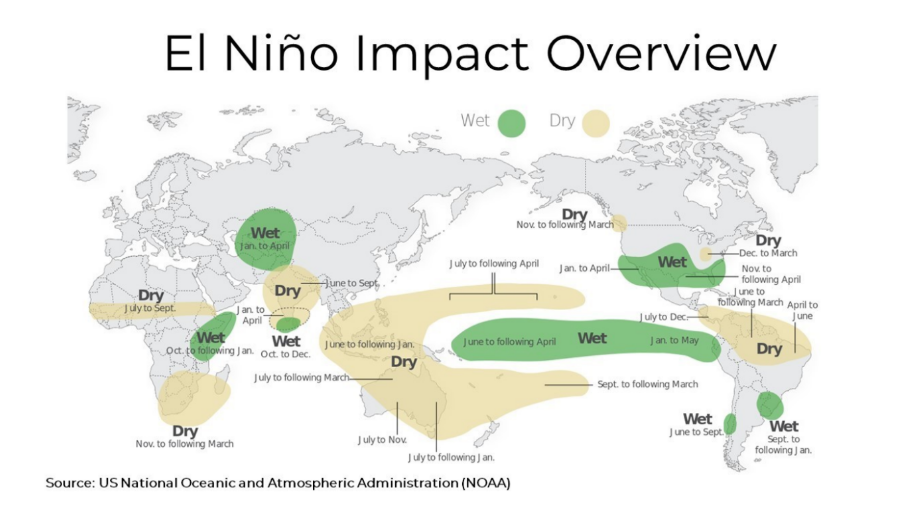
El Niño is what we usually call the warm phase of the El Niño-Southern Oscillation (ENSO), a climate phenomenon driven by abnormal warming of sea surface temperatures in the equatorial Pacific Ocean.
Although it is a localized event, El Niño’s effects extend far beyond the Pacific, altering atmospheric circulation patterns across the globe and affecting rainfall, temperatures, humidity, and storm activity.
[Want better cocoa market insights? Start a free trial of our Premium Cocoa Market Research today.]
In agricultural markets, El Niño is closely monitored because it frequently changes weather conditions in tropical producing regions. Some areas become significantly drier, while others experience excessive rainfall and flooding.
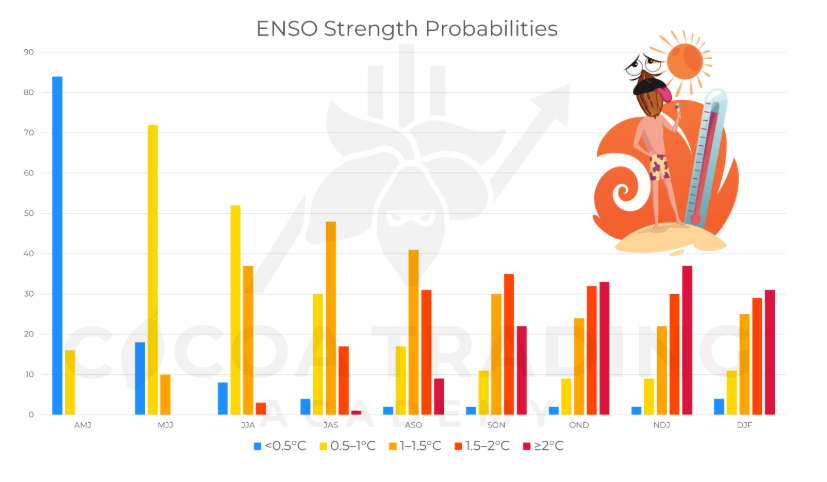
Recent forecasts from the NOAA Climate Prediction Center and the International Research Institute for Climate and Society (IRI) indicate that the probability of El Niño development has increased sharply in recent months. NOAA’s May 2026 outlook showed >90% of an El Niño materializing in the second half of 2026.

That said, not all El Niño events have the same intensity. While some remain relatively moderate and produce limited disruptions to global weather patterns, others are significantly more intense.
In the most extreme cases, meteorologists classify the event as a “super El Niño”, generally defined as warming above 2.0°C in the central equatorial Pacific Ocean for a sustained period. Only a handful of recorded events, including the 1982/83, 1997/98, and 2015/16 episodes, have reached this category.
Such a strong El Niño tends to amplify the typical impacts associated with ENSO. Rainfall deficits often become more severe in some tropical regions, while excessive precipitation, flooding, and temperature anomalies intensify in others.
Although there is still no certainty regarding the severity of the developing El Niño, recent discussions among climatologists and weather agencies suggest that it could potentially evolve into a very strong, or even super, event. Some of the main reasons behind this concern include the unusually warm subsurface Pacific waters and the rapid transition from the previous La Niña phase, which were indicators of major El Niño events in the past.
That said, while the El Niño formation now looks almost certain, its final intensity remains unclear, ranging from moderate to strong, or even a potential super El Niño.
West Africa Impact
With El Niño emerging and the possibility that it may be strong, the cocoa market focus naturally shits to is West Africa. The region remains the core of global supply, with Ivory Coast and Ghana producing about half of the world’s cocoa, along with additional output from Nigeria and Cameroon.
Historically, El Niño has often been linked to lower rainfall and above-average temperatures in parts of West Africa during key cocoa development stages, such as the growth phase (Jun-Oct). That does not mean every event brings drought, but it does raise concern because cocoa trees need stable moisture.
Prolonged dryness can reduce flowering, increase flower abortion, limit cherelle development, and weaken bean filling, while higher temperatures can intensify evapotranspiration and tree stress, especially on farms with poor shade cover or degraded soils.
[Stay ahead of cocoa market moves. Try our Premium Cocoa Research free and see the difference.]
For 2026/27, the main risk is that below-average rainfall could further deplete soil moisture after several years of climatic stress. A hotter, longer dry season would be especially challenging for younger trees, whose share has risen since the 2024 price rally encouraged new planting.

If a super El Niño does develop, these risks would likely intensify, with longer dry spells, stronger heat anomalies, and more severe physiological stress on trees across vulnerable areas. Previous El Niño episodes have often raised concerns about smaller crops, irregular flowering, and lower yields in West Africa.
Because the region has not fully recovered from the 2023/24 shortage, it’s especially sensitive to weather/production shocks, so a strong El Niño could delay any meaningful production recovery for another season.
In the past (2015/16), a super strong El Niño events seem to have contributed to production losses in Ivory Coast.

South America Impact
In South America, the El Niño effects are considerably more complex, as rainfall responses differ substantially between countries and producing zones.
Although the main regions should still suffer from the event, the overall balance is less negative, and some areas might even benefit from it.
Ecuador
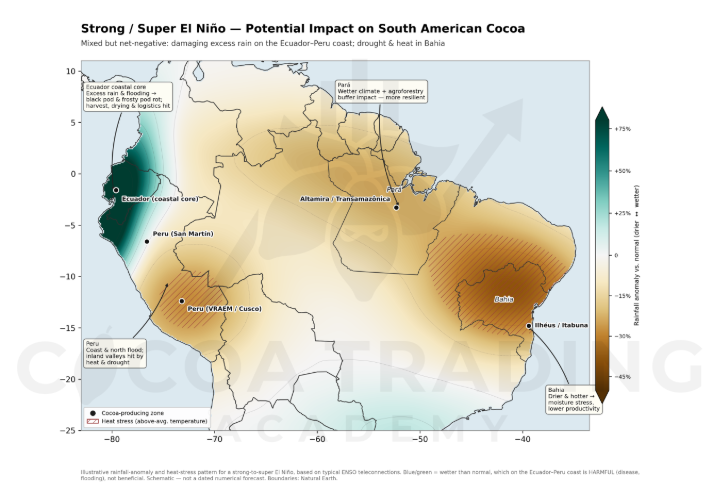
In Ecuador, the world’s fastest-growing cocoa producer, El Niño is often associated with above-average rainfall, particularly in coastal areas. If projections suggested a mild El Niño, this would be considered positive for crops overall.
But in the case of a strong El Niño (which seems to be shaping), excessive rain can increase fungal diseases, especially black pod disease and frosty pod rot. Persistent humidity also complicates harvesting and drying operations, potentially reducing bean quality.
[Looking for reliable cocoa analysis? Sign up for a free trial of our Premium Cocoa Reports.]
In addition, there are even flooding risks that can damage rural roads and logistics infrastructure, delaying bean transportation, and export flows.
Some areas, especially those further away from the coast, might still see benefits due to increased rain at a moderate level. But considering most of the production is concentrated in the coastal areas, this will do little to mitigate the effects on overall production.
In the past (2015/16), a strong El Niño correlated with production losses in Ecuador.

Peru
The situation is more complex in Peru, since El Niño impacts can vary depending on elevation and regional atmospheric circulation. That said, the overall balance leans negative / adverse, with some exceptions.
In certain higher-elevation or typically cooler zones of the Peruvian Amazon, the atmospheric warming brought by El Niño can act positively by accelerating cocoa pod development and extending the active growing season. Moreover, if rainfall does not become too excessive, it can contribute to boosting soil moisture and help farmers optimize yields in regions that are traditionally restricted by lower temperatures.
[Follow cocoa supply, demand, and pricing trends with a free trial of our Premium Research.]
On the other hand, El Niño could also hurt Peru through weather extremes, with flooding in coastal and northern regions increasing disease pressure, while heat and drought in inland valleys may trigger pod drop, poor bean development, and crop losses.

Brazil
Brazil should also not expect a positive outcome from the El Niño. In the country, cocoa production is concentrated mainly in Bahia and Pará, and its effects differ between the two regions.
Bahia has mostly experienced drier and hotter conditions during the El Niño years, potentially increasing moisture stress and limiting productivity. Pará, though, is generally considered more resilient due to its structurally wetter climate and widespread agroforestry systems, which help preserve soil moisture even during drier periods.
As a result, while El Niño cannot be framed as beneficial for Brazilian cocoa crops, it also does not pose a major threat to production.

Conclusion
The growing probability of an El Niño event during the 2026/27 season is drawing some concerns over its potential impacts on cocoa production. This is amplified by fears that this year’s El Niño could be strong.
Notably, a strong El Niño can adversely affect the cocoa crops in West Africa and South America during critical stages, so caution is justified.
The risks are more severe in West Africa than in other growing regions, where hotter and drier conditions could reduce soil moisture, stress cocoa trees, and limit yield potential. In South America, though, the impacts are likely to be more heterogeneous, although crops could still suffer if the event is extreme.
While global supplies are already under pressure after several difficult seasons, an El Niño could have an outsized impact on the market, if extreme. So, the key variable is intensity: it could represent only a mild annoyance to cocoa (with some regions even benefiting from it), or a new cocoa crisis, if extreme.
[Curious what’s driving cocoa prices? Explore our Premium Cocoa Research with a free trial.]


Comments