The Impact of the US-Iran Conflict on Cocoa - Part 2
Introduction
The US-Iran conflict shocked international markets and introduced upside and downside volatility across currencies, equities and commodities. Supply chains were disrupted by the closure of the Strait of Hormuz, one of the most important waterway passages for global commerce. Despite being deeply affected, though, cocoa prices remained relatively stable, as most impacts balanced each other out.
In the first part of this blog series, we saw the most immediate changes caused by the war, and how they influenced cocoa markets, either pressuring prices up or down. Now, we will investigate the medium- and long-term changes that could come from it.
[Looking for reliable cocoa analysis? Sign up for a free trial of our Premium Cocoa Reports]
Unlike the previous blog, some of the shocks described here might take a while longer to materialize and, if the war ends soon, might not happen at all. Still, just their possibility is powerful enough to influence prices, and if they do come, the full effects would be devastating. In this sense, understanding how things might play out in Iran becomes a necessity for anyone who wishes to stay ahead in the cocoa markets.
Inflation Hedge
One of the main ways the US-Iran war might affect the market’s perception of cocoa is by seeing it as a possible hedge against inflation.
After the initial effects of the war appeared, one thing that instantly became a point of concern was inflation.
In the first part of this blog, we mentioned how the closure of the Strait of Hormuz led to rising oil prices, which in turn contributed to pressuring cocoa upward. Cocoa was not the only thing to rise due to fuel costs; quite the opposite, actually.
Oil is one of, if not, the most essential components of the globalized economy, meaning that its disruption led prices to surge all over the world. As this effect starts to be felt - a process that happened almost immediately but takes a few months to completely materialize - investors will look for ways to protect themselves from inflation.
In this case, commodities appear as some of the best solutions. Since they are directly linked to the source of inflation in many respects, their prices are expected to rise along with it. At the same time, commodities are easy to diversify through funds, meaning that investors see them as a safe way to hold their patrimony.
As a result, inflationary pressure increases demand for cocoa, leading it to appreciate. Although this demand is not concentrated solely on cocoa, its sheer volume is so intense that, even divided through all the commodities funds allocate into, it is still enough to become a significant driver of the market.

Passive Commodity Index Allocation
Once again considering the relation with funds and other commodities, another indirect way the war might affect cocoa is through index rebalancing.
As we mentioned before, the actual impact of the US-Iran war on cocoa prices was relatively mild. That, though, cannot be said of all commodities, as some futures saw huge price surges in the last few months. When considering other agricultural commodities, a clear example of this was cotton, whose price rose over 20% since the beginning of March. Going beyond the softs, there are even starker examples, like oil itself, which is also a commodity.
[Get the cocoa market research professionals follow. Start your free trial today.]
Along with cocoa, these are included in commodity funds, which keep a regular distribution of their portfolios through the listed futures. Considering other commodities saw huge rallies while cocoa remained relatively stable, the future adjustments are bound to increase demand for the crop.
That said, we must remember that index rebalancing happens at the beginning of the year, meaning we are still a while away from it, and much could change in the meantime. The reaching of an agreement to end the conflict, or even a prolonged ceasefire that allowed the Strait of Hormuz to reopen, for example, could topple the prices of the rallying commodities, bringing everything closer to what it used to be and reducing the intensity of the funds’ adjustment.
If the conflict persists and prices remain elevated, though, the expectations of a favorable index rebalance for cocoa should be bullish for prices, especially in the last quarter of the year.

Interest Rates
Another relevant way the US-Iran war impacted cocoa prices is through interest rate expectations. Even among other shocks, though, this is one of the most nuanced, and even determining its full effects is not currently possible.
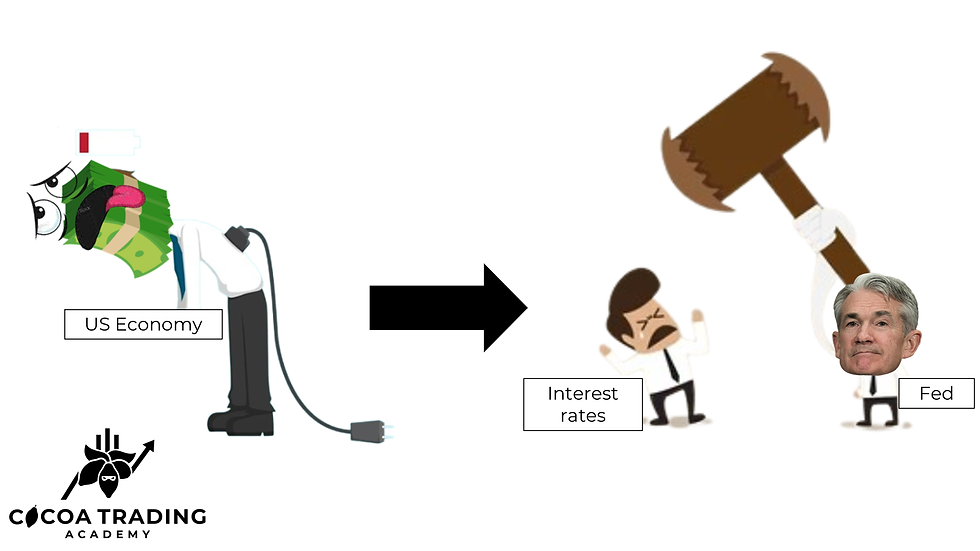
Interest rates are the main mechanism by which the Federal Reserve interferes in the economy, mainly used to regulate growth and inflation. If prices rise too much, the Fed increases rates - which is done by reducing the rhythm of expansion of the monetary base - to keep inflation inside the target. On the other hand, if inflation is too low, or the economy is too weak, presenting low GDP growth or high unemployment, the Fed will reduce interest rates to stimulate it.
Although controlling inflation is usually seen as the main duty of the central bank, in reality, it also considers other variables to determine its monetary policy, making it harder to precisely predict what it will do.

Increase
As we mentioned before, the US-Iran war pressured inflation by increasing oil prices. This led the market to increase its interest rate expectations for 2026; at the beginning of the year, most agents expected rates to be cut by 0.50% or 0.75% by December. Now, though, the dominant view is that rates will remain at their current level, 3.75%.
[Curious what’s driving cocoa prices? Explore our Premium Cocoa Research with a free trial.]
The expectation of higher interest rates is, along with investors’ risk aversion, one of the main reasons behind the strengthening of the USD. At the same time, it reduces demand for riskier assets, as the market has the option to buy Treasuries at higher rates, which are usually considered risk-free by most investors. Both these factors are bearish for cocoa.

Decrease
On the other hand, the oil rally not only increased inflation, but it also reduced the global growth prospects for 2026. Just as we said earlier, although the Fed wishes to keep inflation around the target, it will also look at other variables to decide what the best course for interest rates is.
One of these other variables is, without a doubt, growth. If the economy is too weak, the Fed might choose to prioritize it instead of controlling price levels. If that is the case, we might actually see interest rates going down instead of up, catching the market by surprise. Opposite to what we said earlier, lower interest rates would lead to a weaker dollar and higher demand for risky assets, since Treasuries would be paying less. These factors would be bullish for cocoa.
[Stay informed on global cocoa developments. Sign up for a free trial of our Premium Reports.]
In this context, even though the markets have increased their interest rate forecasts, we cannot know for sure if it will come to pass. After all, we have not fully felt the impact of the conflict on the economy, be it on price levels or activity. Depending on the intensity of each one, as well as the view of the Chair, the Fed might reduce, increase, or keep interest rates stable, all of which will have different effects on cocoa prices. Most likely, these decisions will also be affected by the scale and duration of the war, both of which are still unknown.
Fertilizer and Input Cost Rise
Last but not least, we must consider the impact of the US-Iran war on fertilizer access for cocoa farmers.
While most of the themes discussed in part two of this blog regarded mainly the financial markets, the fertilizer matter concerns an essential aspect of cocoa fundamentals, since it directly affects yields and, therefore, production as a whole.
The blockade of the Strait of Hormuz made transportation of a series of products far more difficult, as they were forced to change their shipping routes, sometimes increasing the time and investment needed to reach their destination severalfold. While cocoa was not transported through the Strait (although it was still affected by the blockade), fertilizers were. Around 30% of the global fertilizer trade was done through Hormuz, coming mainly from Persian Gulf nations, such as Saudi Arabia, Qatar, and even Iran itself.
[Get a closer look at the cocoa market. Start your free trial and access expert analysis.]
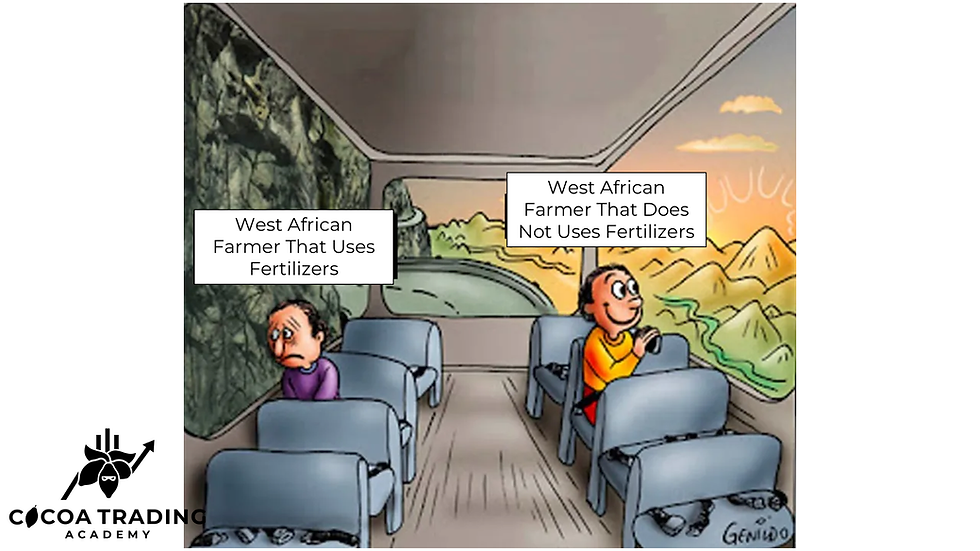
Fertilizers are an important aspect of cocoa farming, and their lack is likely to be felt in the field, as yields drop. This will be particularly harmful to West African farmers, since they were more dependent on fertilizers from the Gulf, unlike producers from other regions, such as South America, which also import fertilizers from Russia. When we consider that West African farmers also have far less access to capital, they are bound to feel the price increase more sharply.

Dire as the situation might be, though, we must also take some other aspects into account. The first is that the fertilizer needed for the 2025/26 crop has already been applied, meaning that the effects of the shortage will only be felt next season, which begins in October.
The second aspect is the usual situation of West African farmers. Factors such as lack of capital and education already influenced cocoa farming in the region long before the US-Iran war began, having terrible consequences for producers.
One of these is that they already do not apply as much fertilizer as they should; in fact, it is estimated that less than 30% of West African cocoa farmers use fertilizers at all. Although those farmers will feel the shortage heavily, it also means that more than two-thirds of cocoa producers will not be affected.
The fertilizer shortage is a bullish factor for cocoa, and one that is already weighing on the markets. That said, its actual effects will still take months to materialize, and their impact could even be smaller than what many analysts expect, considering that it will only affect a minority of producers.
Conclusion
The US-Iran war brought a myriad of different impacts to the cocoa markets, ranging from instantaneous to long-term, from bearish to bullish, and even dubious. Each of those pressured the market in its own way, leading prices to rise or fall depending not only on what happened, but also on what investors believed could happen.
The war itself, though, is still an ongoing process. No one is sure if it will be over tomorrow or last for another year and, therefore, how long it will continue to drive the markets.
Even if it is finished in the near future, many of its effects will persist. For that reason, understanding what they are, which ones already influenced prices, which ones might disappear, and which ones are expected to last is essential for traders, investors, and anyone else who wishes to thrive in the wild waters of the cocoa markets.
[Enjoyed reading this? Sign up for our Premium Cocoa Market Research for more reliable analysis and market insights.]


Comments