Cocoa Origin Focus - Nigeria Part 2

Origin Focus: Nigeria
Nigeria At-a-Glance
Production: Average production of approximately 250,000–300,000 tons annually over the past decade.
Global Ranking: Typically the world's fourth- or fifth-largest cocoa producer and Africa's third-largest producer.
Cocoa Types: Predominantly Forastero and improved hybrid varieties developed by the Cocoa Research Institute of Nigeria (CRIN).
Harvest: Main crop from October to January; mid-crop from April to June.
Harvesting: Entirely manual.
Key Producing States: Ondo, Osun, Oyo, Ogun, Ekiti, Cross River, Edo, and Akwa Ibom.
Climate: Humid tropical conditions with annual rainfall generally ranging from 1,250 to 2,500 mm.
Farm Structure: Approximately 98% of production comes from smallholder farmers.
Average Farm Size: Typically between 2 and 5 hectares.
Processing: Growing domestic grinding industry, though the majority of production is still exported as raw beans.
Introduction
Nigeria is a relevant player in global cocoa markets. Despite not being in the same league as its neighbors Ivory Coast and Ghana, its output is still a key contributor to global supply.
However, that has not always been the case. Nigeria was once among the world's cocoa leading producers. As we saw in the first part of this blog, though, the situation changed when the country was hit by a severe crisis of Black Pod Disease, severely damaging the crop and revealing the shortcomings of the state-managed system.
In the second part of this blog, we will see how Nigeria recovered from its darkest times, growing into the mid-sized producer it is today. More than that, we will investigate the challenges that have stopped this West African nation from rising even further, and what we can expect from it in the coming years.

Winds of Change
Government reforms in the 1980s helped revive Nigeria's cocoa industry by improving production incentives.
Just as the cocoa boom faltered, the dark days of Nigeria’s cocoa sector did not last forever. In 1986, facing a severe debt and fiscal crisis, the Nigerian government adopted a sweeping Structural Adjustment Programme (SAP) backed by the International Monetary Fund and the World Bank.
The SAP adopted a series of policies focused on reducing the economy's reliance on crude oil exports and imported consumer goods, as well as tightening fiscal control and adopting managed but market-determined exchange rates. For the cocoa sector, though, the main changes came from the sudden abolition of the state marketing boards.
[Stay ahead of the cocoa market. Explore our Premium Cocoa Research plans for ongoing insights and analysis.]
The dissolution of the allegedly corrupt and inefficient regulatory apparatus allowed a wave of private domestic traders and multinational commodity merchants to enter the market, forcing exporters to compete aggressively for volume and shifting commercial leverage directly into the hands of producers. This was also supported by a strong devaluation of the Naira (Nigeria's official currency), multiplying domestic nominal prices.

Faced with these powerful price incentives, the rural population mounted a swift and robust supply response, returning to the plantations they had abandoned during the height of the oil boom. Since newly planted trees take many years to bear fruit, they focused mainly on rehabilitating the existing crops.
With more hands and fresh liquidity, families resumed work on abandoned farms, quickly bringing production levels back to where they were before the collapse. While the 1987 crop amounted to only 150 MMT, it massively increased only one year later, to 250 MMT.
From there, the cocoa crop continued its uptrend, which lasted as long as the previous decline. Production increased for almost twenty years, until it reached its peak in 2006, when over 480 MMT was harvested.

Halted in Its Tracks
Unfortunately, it seemed as if Nigeria was doomed to remain stuck between glory and collapse. Just as the country was beginning to pose a real competition to the cocoa powerhouses (trailing Ghana’s crop by only 100 MMT), production crashed, falling from 485 MMT to just 360 MMT in 2007.
This abrupt decline was caused by a devastating Black Pod Disease (BPD) crisis, which began after an abnormal period of excessive rainfall and high humidity. The disease affected most West African origins, but it was particularly devastating for Nigeria, which was at the apex of its expansion phase.

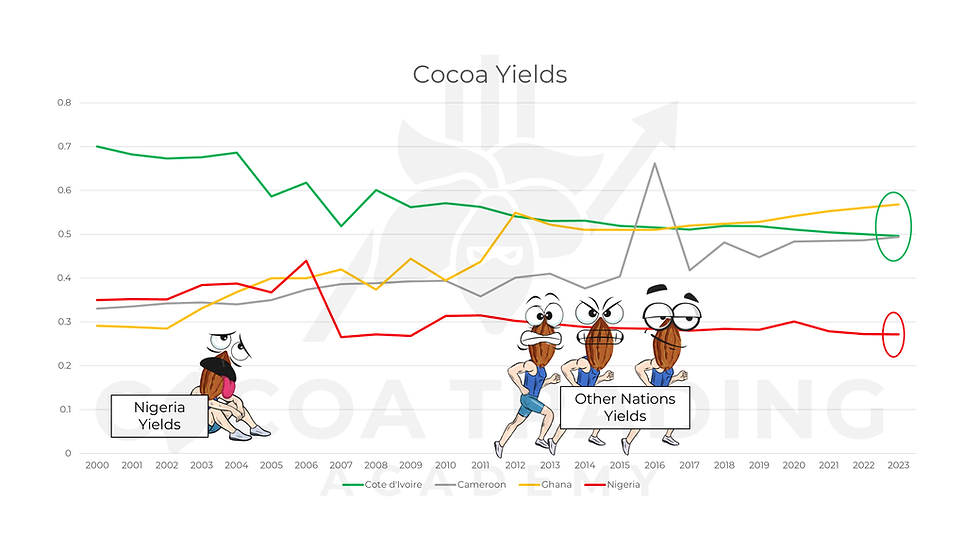
Despite being a specific event, the BPD brought to light many structural problems that remained in Nigeria’s cocoa sector. Even though improvements were brought by the liberalization reforms, the country still had extremely low yields, hovering around 0.3 kg/ha. Although this was superior to the 1980s, when yields could be as low as 0.2 kg/ha, it was still one of the lowest numbers seen in West Africa.
[Looking for consistent cocoa market coverage? Our Premium Cocoa plans deliver regular, data-driven updates.]
The low yields were caused by a lack of proper farm management and investment in new genetically altered seed varieties. At the same time, farmers neglected the planting of new trees after returning to the fields, meaning that most of the plants had been sown in the 1960s and 1970s, before the oil boom destroyed the sector. Now, those trees were over thirty or even forty years old, far away from their biological peak, especially after being hit by the BPD.
Stagnation
Almost twenty years have passed, but Nigeria has not been able to fully recover from the damage caused by Black Pod, nor has it been capable of fixing the structural problems that remained in its cocoa sector. As a result, production has been stuck in the 250 MMT–350 MMT range, although an uptrend was seen in the first half of the 2020s.
At the same time, the dominance of the oil sector continues to pose a serious problem for cocoa production. Even though farmers are now able to keep a larger share of the prices paid for the beans, competition with urban wages makes it harder to attract younger generations.
This also creates a problem regarding technical advancement, since the lack of new blood leads the older cocoa farmers to become the backbone of the sector. Since they are used to a lifetime of cocoa farming, it is harder for them to apply the new techniques and advancements that are developed, which other countries have used to increase their yields as well as total production.

A New Hope
After twenty more years of stagnation, a fresh opportunity seems to have been found for Nigeria’s cocoa sector. The 2023/24 crisis devastated the cocoa production of the two biggest producers, Ivory Coast and Ghana. Due to the shortage, prices spiked, reaching an all-time high of $13,000/MT.
While its neighbors suffered, Nigeria itself saw little to no impact on its crop. Meanwhile, the prospect of higher profits generated new interest in the cocoa sector. Investment surged, while farms that remained abandoned despite the 1990s recovery were reactivated.
[Get deeper insight into cocoa supply and demand. Our Research plans keep you updated on key market drivers.]
Much as happened in the second half of the 1980s, the effects of a new cocoa resurgence will take a few years to materialize (and will be affected by short-term drivers, such as El Niño) but it is possibly that we will see an upward trend in Nigerian production in the coming years, based on economic incentives.

Rocks in the Road
That said, not everything is rosy. The 2023/24 shortage has been mitigated, and although Ivory Coast and Ghana have not fully recovered yet, their 2025/26 crops are already substantially above the lows of a few years ago. Meanwhile, other nations, such as Ecuador, managed to move ahead of Nigeria, increasing their production by a substantial amount in a short time and capturing most of the lost market share.
These events led cocoa prices to drop in 2025 and the first half of 2026, making them only an echo of what they were less than two years ago. Although cocoa still trades above $5,000/MT, a level that would have been unthinkable before the shortage, it is less than half of the price that led to all the investments and projects being built in the sector.
At the same time, the nemesis of the Nigerian cocoa sector looms on the horizon. The recent conflict between the US and Iran led oil to rally, surpassing $100. Although prices have declined, they remain above $80, and the persistent tensions between the two countries leave the markets at constant fear of a new uptrend. Strong oil prices, with the possibility of becoming even stronger in the future, might lead the Nigerian oil industry to expand even further, attracting labor that would otherwise be channeled into cocoa, as happened in the 1970s.
[Make more informed decisions in the cocoa market. Subscribe to our Premium Cocoa Research plans today.]
Combined, these factors might lead Nigeria to remain behind its competitors, both in terms of total investment, yield, and production, all of which are interconnected. If the West African nation cannot solve the first, it will be unable to increase the second, which is currently the biggest hindrance to the latter.

Conclusion
Despite all its setbacks, Nigeria worked hard to recover from the crisis that devastated its cocoa sector. It reformed its failed system, allowing cocoa farming to compete with the dominant oil sector on, if not equal, at least closer ground than before.
Unfortunately, positive as they were, the reforms proved insufficient to bring the country’s full potential to life. Instead, Nigeria remained a mid-size producer, dwarfed by its bigger neighbors, Ivory Coast and Ghana.
Now, though, a new opportunity has emerged, as the giants were heavily hit by a shortage crisis, leading cocoa prices to skyrocket. The higher profit margins could be the driver that will allow Nigerian farmers to boost production, invest in ways to increase their poor yields, and compete with the oil sector for the labor it desperately needs.
That said, time is of the essence, and Nigeria is lagging. While other countries, such as Ecuador and Brazil, have already shown considerable crop growth since 2023, Nigeria’s is moving slowly, with production still at a similar level to what was seen before the shortage. If the country does not increase production and improve its farming practices while prices are still high, it may lose another opportunity to change its own fate and that of the whole cocoa industry.


Comments