What to Expect from the 2026/27 Cocoa Season - Part 1
Updated: Sep 3

Few commodities have given traders as wild a ride as cocoa over the last three years. The 2023/24 West African shortage sent prices to levels no one thought possible, surpassing $12,000/MT. Then came the hangover, as demand buckled under those prices, grinding figures were crushed, supply began to recover, and the market collapsed all the way back toward $3,000/MT by early 2026.
Now, though, the pages of history are about to turn once more, as we near the end of the 2025/26 season and the beginning of a new chapter for the cocoa market.
In this article, we will walk through what the upcoming season is likely to bring, where production is heading in the major origins, how demand is behaving, why the weather has become the single most important variable, and what all of it means for the stocks that ultimately anchor the price.
From Crisis to Surplus
The cocoa market enters 2026/27 in a much healthier position than it was two years ago, with production recovering and inventories rebuilding. But the sharp price rebound in 2026 shows that the market remains highly sensitive to supply concerns, setting the stage for another volatile season.
The 2026/27 cocoa season officially starts on October 1, so it's a little over a month away. That said, Ivory Coast and Ghana announced they will begin the season on September 1. No matter the official date, though, events of the new season are already unfolding, and will only intensify in the coming weeks.
[Upgrade your cocoa market understanding. Join our Premium Research plans for ongoing insights and analysis.]
To understand 2026/27, it helps to remember how quickly the ground shifted. The 2023/24 deficit of nearly 500 MMT drove the market to records and pushed the global stocks-to-grindings ratio to a 46-year low near 27%. That scarcity was the engine that made the rally possible.

The two seasons that followed reversed the story, though. Even if 2024/25 did not show a full recovery, the combination of slightly higher production figures and extreme demand decline were enough to bring the balance back into surplus territory. For 2025/26, conditions improved further, with Ivory Coast’s production nearing pre-shortage levels and many smaller producers showing a considerable crop increase.
Back-to-back surpluses allowed inventories to start rebuilding, and prices fell by about half in the first weeks of 2026 alone.

By late February, cocoa was trading near $3,000/MT. This level was still higher than anything seen before the shortage, but it suggested the natural order was being restored. But, as we all know, normality in cocoa never lasts long, and by the middle of the year, the market had rebounded hard, briefly touching an eight-month high above $6,400/MT in early July. This turnaround was the perfect herald for the 2026/27 season.

El Niño
El Niño is emerging as one of the biggest risks to the 2026/27 cocoa crop. It is particularly disturbing for cocoa, as West Africa's main crop, the bulk of global supply, is developing and maturing precisely during the window when a strong El Niño tends to bite.
The event typically tilts the region toward hotter, drier conditions and a harsher Harmattan, the seasonal dry wind that sweeps down from the Sahara between December and February. We also cannot forget that the catastrophic 2023/24 crop failure unfolded during the last El Niño, a precedent the market has not forgotten.
[Stay ahead of the cocoa market. Explore our Premium Cocoa Research plans for ongoing insights and analysis.]
At the same time, the near term has not been kind to cocoa producers. Over recent weeks, heavy rains have flooded farms across Ivory Coast and Ghana, disrupting harvesting and drying and raising the risk of black pod, the fungal disease that thrives in wet conditions. This means the weather threat runs in both directions: too much water now, with the risk of too little later.

Between Highs and Lows
West Africa remains the key risk to cocoa supply. Ivory Coast is coming off a strong recovery, but early signs point to a much weaker 2026/27 crop, while Ghana continues to struggle with structural production problems. At the same time, the two countries are trying to strengthen their influence over the global market, but their ability to do so may be limited by declining market share.
Ivory Coast
Despite its recent setbacks, Ivory Coast remains the axis around which everything turns, favored by a strong 2025/26 recovery. The Coffee and Cocoa Council (CCC) raised its 2025/26 estimate to about 2,200 MMT, a solid recovery of more than 10% and a sign that the days of crisis were gone. Even with the recent controversy, port arrivals supported this scenario, remaining far above 2024/25 levels.
The problem is what comes next. Early surveys of the 2026/27 crop show below-average cherelle formation. That weakness, combined with El Niño risk and lingering fertilizer and management issues (a possible consequence of the US-Iran war), has led to preliminary estimates near 1,800 MMT for 2026/27, almost 20% below the current season. If that holds, much of the comfort provided by two years of surplus will be gone in a heartbeat.

Ghana
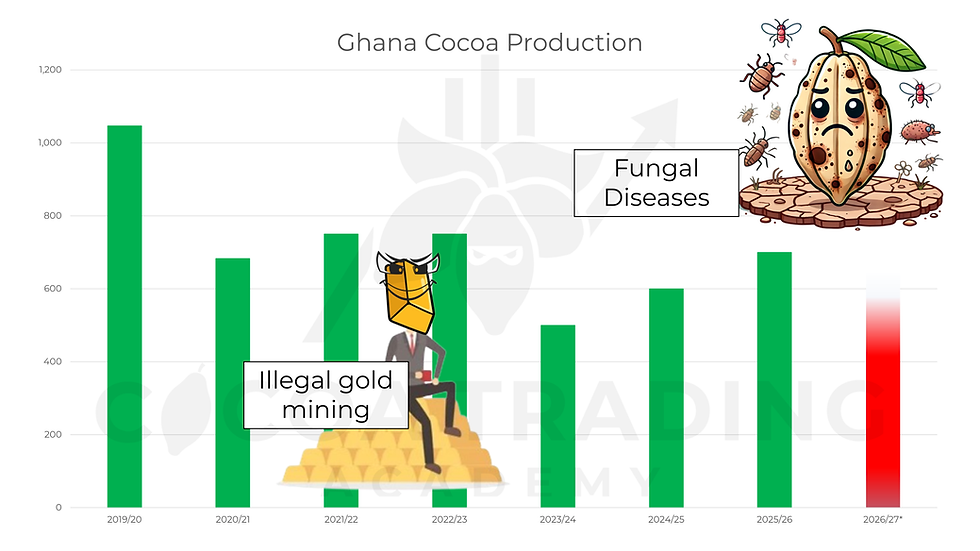
Ghana, meanwhile, is the more chronic case. The country has struggled to escape a multi-year decline driven by aging trees, the relentless spread of Cocoa Swollen Shoot Virus, and the encroachment of illegal gold mining on cocoa land. Output might have rebounded to above 600 MMT, but that is still far below its historical norm, and the government's old target of 1,500 MMT now looks fanciful.
[Join our Premium Cocoa Research plans and stay informed year-round.]
That backdrop makes the most important policy development of the year so far worth watching closely. On 16 June 2026, the presidents of Ivory Coast and Ghana signed a Joint Declaration to harmonize their farmgate prices in dollar terms and align their crop calendars from 2026/27, adopting a single 1 September to 31 August season. Global markets quickly saw it as an attempt to build a "cocoa OPEC," which became even more pronounced as Ivory Coast invited Cameroon and Nigeria to join.
The new attempt to cartelize international cocoa markets is already in a fragile situation, though. Despite still accounting for over 50% of global production, Ivory Coast and Ghana are not as dominant as they used to be, both due to the crop decrease and the output rise in other nations.
Considering many of these countries are not included in the Joint Declaration plans, this might limit Ivory Coast and Ghana’s ability to manipulate the markets.
The Newcomers
While the West African nations wrestle with the possibility of a new shortage, the more optimistic part of the cocoa story is unfolding elsewhere. As we mentioned before, prices reaching historical highs above $12,000/MT convinced many countries that cocoa farming could actually be a relevant economic activity, leading new projects to pop up all over the world.
The biggest example of this is, of course, Ecuador. Although the country had already been in a crop uptrend for a few years, 2025 was when production truly spiked, surpassing 500 MMT for the first time in history and coming dangerously close to Ghanaian levels, something that is expected to continue this year, as the export association projects shipments above 620 MMT.
[Looking for consistent cocoa market coverage? Our Premium Cocoa plans deliver regular, data-driven updates.]
That trajectory, along with the fact that Ghana is expecting a terrible crop in 2026/27, puts Ecuador on course to become the world's second-largest producer. Even if a new crop record is not reached next season, a strong possibility since El Niño will also have a negative impact there, it is unlikely that Ecuadorian production will drop enough to let Ghana keep second place.
Meanwhile, also in Latin America, Brazil is enjoying a genuine comeback, with 2026 output recovering above the 270 MMT range on the back of new plantings and high prices. Although Ecuador has pulled ahead, a good part of its potential has been realized.
The biggest Latin American nation is still far from what it could be, with the projects started in 2024 only now beginning to bear fruit. This means that we might expect a stronger Brazilian crop in 2026/27, maybe above 300 MMT, even if El Niño applies negative pressure to production.

Conclusion
So far, the 2026/27 promises to bring a great seatback, reversing most, if not all, the recovery done by West African in the previous two years. At the same time, it could represent hurdle to the continued growth of South American producers, though it is unlikely it will completely halt the uptrend there.
In the second part of this blog series, we will see what the coming season might bring in terms of demand, and how the cocoa stocks might be impacted by the changes in both production and consumption.
[Sign up for our Premium Cocoa Research plans and never miss key updates.]


Comments