Why There’s Only One Arabica Coffee Exchange?


When teaching about the coffee futures market, one common reaction we get from our students is a mix of confusion and discomfort:
“How can there be just one major exchange setting rules for Arabica coffee all over the world?”. “Is it privately owned?”. “Isn’t that problematic?”.
These are fair questions. Market dominance by a single corporation feels contrary to free and fair markets.
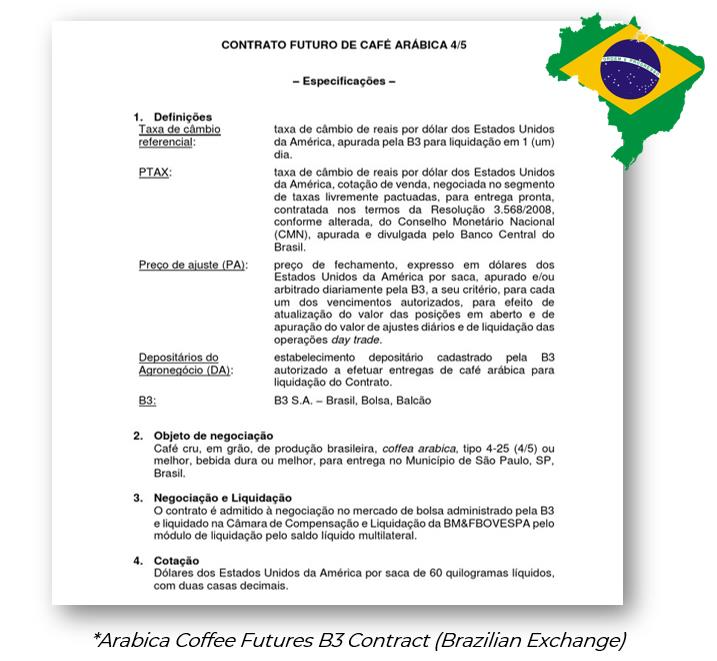
While it is true that there are other peripheral Arabica coffee exchanges, like B3 futures contract in Brazil and the Nairobi Coffee Exchange’s auction system in Kenya, the reality is: there's one market that is dominant for global trade, and that's the ICE.
However, in this article, we will see how this concentration isn’t a flaw, but rather a reflection of how commodity markets function. Over the next few paragraphs, we’ll see how having a single exchange is probably the optimal scenario compared with the alternatives. To that end, we’ll break down how the Intercontinental Exchange (ICE) works, why it feels like a monopoly, and why no major competitors have emerged.
[Stay ahead of the coffee market. Explore our Coffee Research plans for regular insights on supply, demand, and pricing.]
The ICE Exchange in a Nutshell
First, we need to understand what the ICE exchange is: a global marketplace where people trade standardized forward contracts tied to physical assets like coffee, sugar, oil, and other commodities.
This standardization provides the hedging infrastructure that allows buyers and sellers to manage risk around the world: they gain access to a transparent, universal coffee prices and can manage price risk by hedging with uniform, liquid, futures contracts.
So essentially, the ICE exchange does following three things:
Trade execution: it matches buyers and sellers, while guaranteeing trades are honored
Risk management: it offers a price hedging mechanism against the physical commodity
Price discovery: it’s where global price gets formed
This applies across multiple commodities on a global scale. Given the dominant position of the ICE, it would seem like this would be a valuable entity to own. So, who owns it?
ICE is a private, for-profit, publicly listed company owned by institutional investors and shareholders. Unlike like central banks or public exchanges, it is completely private (non-government owned).


The Common Misconception
When traders place orders on the exchange, they don’t see who is on the other side of the trade, as they only interact with the exchange itself. Because of this, many people think that they are trading with the exchange. However, this is not the way it works: the exchange isn’t your counterparty, but rather a platform that facilitates trade between participants.
As an example, let's say there is an exporter and a roaster trading at ICE. The exporter submits a “sell order”, while the roaster submits a “buy order”. If their prices match, the exchange automatically matches them, the trade is executed, and the exchange earns money by charging a tiny fee for providing the marketplace, clearing and matching engine.

Why if Feels Like a Monopoly
The fact is: commodities are uniform by nature, so an exchange of commodities naturally converges towards a single uniform entity.
However, this concentration toward a single monolithic entity makes the ICE exchange feel like a monopoly, and that’s a valid concern. Monopolies are generally undesirable because they stifle competition and can lead to inefficient practices like setting arbitrarily high prices.
The ICE exchange is a defacto monopoly as coffee globally uses the ICE futures as the price benchmark. This global dependence on a single entity for coffee prices (even if trades happen outside of ICE) implies an enormous influence.
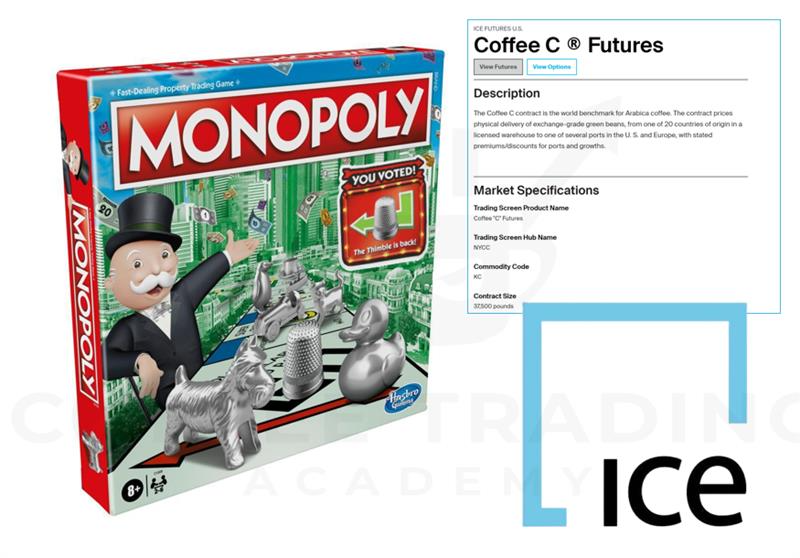
Industry reliance on a single company for a service is completely different from other commercial relationships we’re used to, like those with banks or restaurants, for example.
[Looking for consistent coffee market updates? Our Coffee Research plans deliver expert analysis straight to your inbox. Sign up for a FREE Trial.]
If you don’t like the services of a bank or a restaurant, you can easily switch to another (as there are many competitor banks/restaurants). Whereas with arabica coffee futures, we’re stuck with ICE, as there is no exchange that seriously rivals it.
Despite this dominance, alternative exchanges offering coffee futures do in fact exist, (like Brazil’s B3), so why don’t they serve as true substitutes for ICE?
“Winner Takes All” Dynamic
The reason these exchanges can’t compete with ICE is because of a “winner tales all” dynamic outlined by the Mathew principle. “To those who have everything, more will be given. To those who have nothing, even what little they have will be taken away.”
This principle was described by Robert K. Merton in 1968 and explains how dominance can emerge and persist in social and economic systems. Robert proposed that early advantages reinforce themselves over time, and this idea was widely adopted by economists by the 70s and 80s.
For example, if 4 people in a population of 10 speak English, 3 speak Spanish, 2 speak French and 1 speaks German, then if a new person enters that population, they will learn English because it will allow them to speak to the most people. The next person to enter that population will now have even more incentive to learn English (as 5 people speak it), thereby perpetuating the same cycle.
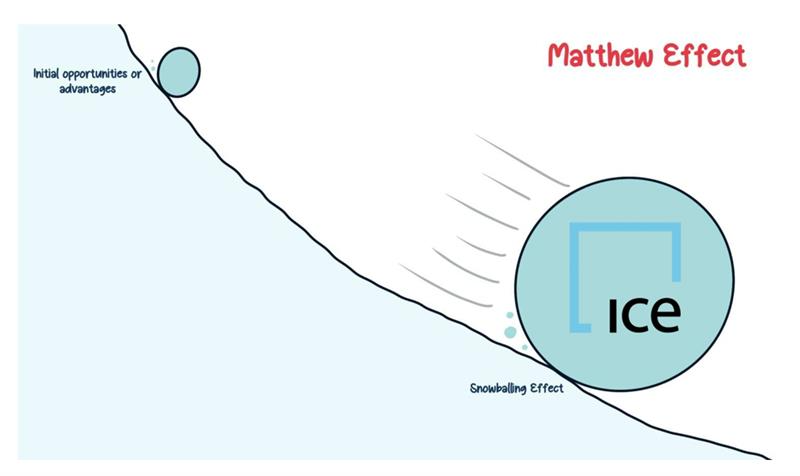
This is an analog to what happens in commodity markets: there is no differentiation between individual goods, so price is primary. The more traders involved, the more attractive the exchange becomes in liquidity terms, as the easier it is to enter and exit positions, the tighter the bid-ask spreads, and the more reliable the pricing.
As an example, let’s say you are an exporter and need to sell 1 container of coffee that is undifferentiated from your competitors’ coffee. Would you rather put your coffee up for sale on an exchange with 100 buyers or 10,000 buyers? Most people would choose the 10k, because it seems much more likely that you would find a buyer willing to pay your price quickly and easily.
This is precisely why liquidity is so valuable: it gives speed, price efficiency, and certainty of execution.
As a result, participants will naturally gravitate toward the most liquid exchange, and once one exchange reaches critical mass, it becomes very hard to displace. This creates a “winner takes all” effect, where the most liquid contract (hence, the biggest exchange) becomes the one everyone prefers. In our case with coffee: that’s ICE.

A Real Example: Cotton
This dynamic isn’t unique to coffee. It shows up in other markets too. Back in 2015, new cotton contracts were launched to better reflect global trade, but they failed to gain traction due to poor liquidity.
The global standard for cotton trading is the US-based ICE Cotton No. 2 futures contract, also on Intercontinental Exchange, and in 2015, this same exchange tried to innovate in what was a fair attempt to improve global trade.
[Follow the coffee market with confidence. Sign up for our Coffee Research plans and stay informed year-round.]
The existing benchmark (Cotton No. 2) only reflects US cotton delivery, but global production was distributed across other origins like Brazil, India and China. So, ICE designed a contract with multiple origins and delivery locations to better reflect the global supply chain. In theory, this was a better representation of global trade.
However, the new contract still failed. Trading began in 2015, but volumes were very low from the start, until finally by early 2017, there were no trades at all, and so ICE discontinued the contract. (Reported by the Business Recorder, June 2017)
It didn’t fail because the idea was flawed, but because it couldn’t attract enough users to reach critical mass. Without users, there’s no liquidity, and without liquidity, the contract simply isn’t usable.

What are the Alternatives
To understand why the coffee market converges around a single exchange, it helps to consider alternatives, as each raises additional problems.
Multiple Exchanges – Same Contracts
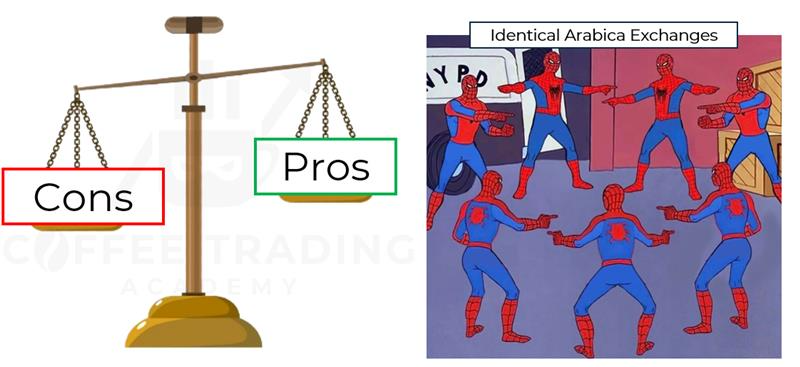
The most obvious alternative would be if there were more competition from exchanges trading an identical contract. However, this would require duplicating systems and infrastructure that otherwise benefit from economies of scale. For example, if there were one exchange, it might require one building and 1000 employees. If there were 4 exchanges, it might require 4 buildings and 4,000 employees as it would require the same number of staff to monitor and facilitate 1,000 or 1,000,000 contracts in daily volume.
Despite this, the main problem is not the overhead but rather that it would fragment liquidity. Trading volume would be split by the number of exchanges, so at a minimum, two exchanges would each capture roughly 50%, while three would have 33% each, and four only 25% of the original liquidity per venue. This would quickly make the volume in illiquid contracts like longer-dated futures and out the money options contracts practically unusable.

Additionally, if the contracts are truly identical, there is no functional advantage to using one exchange over another. They would compete on exchange fees, but in practice, having many competitors may actually be more expensive than a single one, because of the aforementioned duplicates in overhead and infrastructure.
These costs are passed on to the traders indirectly as well. If multiple equally relevant coffee exchanges exist and offer the same contracts, traders must connect to all of them if they want full market access. This increases costs and operational complexity for traders as it requires more systems, people, and processes to manage.
So in sum, having multiple exchanges with identical products adds costs to the exchanges and the traders using the exchanges and reduces liquidity with no tangible benefit.
It’s also worth noting that we do have something similar to this dynamic of multiple exchanges with identical contracts through OTC providers. They provide futures and options based on the ICE prices, and they also provide their own liquidity, so it essentially works as competitors to the exchange, based on exchange prices and standards, but without fragmenting liquidity.
Multiple Exchanges – Different Contracts
If having multiple exchanges with identical contracts is suboptimal, then the obvious alternative would be to have multiple relevant exchanges, but with differentiated contracts rather than identical ones. So, in this case, we have highly specialized exchanges, focusing on specific coffee origins or unique services and each exchange offering contracts tailored around these specializations.
[Our Premium Coffee Research plans provide clear, timely market analysis.]
In this hypothetical system, one exchange could be strong in Brazilian naturals, another in sustainable contracts, another in customer service, another might innovate in crypto or forex payments, and so on. Sounds great, right? More choice would mean more benefit to the consumer, right?

But this leads to a new problem: now, one of the most valuable features of a futures market was lost, there is no longer a single, widely accepted reference price. If coffee prices are now referenced against multiple benchmarks, this creates confusion and miscommunications about what the value of the coffee is.
A roaster exposed to multiple origins would need to hedge across multiple exchanges. Roasters and exporters with their own preferred contracts would be holding hedges that are incompatible with each other, and managing a single trade position would now include multiple commodities and conversions across each. They would need to split hedges across several contracts, decide how much exposure belongs to each exchange and continuously rebalance as their sourcing mix changes.
This reduces the effectiveness of the hedge, as you add conversion costs that may benefit or penalize you depending on which contracts you are converting from and to. This also makes AA’s difficult or impossible, as traders would have to convert their hedges into identical contracts in order to trade with each other.
So, having different contracts would add conversion risk, reduce price transparency, increase costs and complexity of bilateral transactions, and raise the same liquidity problems as multiple identical contracts.

Two Exchanges
If liquidity is so important, then we could consider having two competing exchanges. This is the minimum number of exchanges required for competition thus maximizing liquidity and competition. However, this situation too has its own problems.
First, if the concern with a single exchange is concentration of power, then having two dominant exchanges simply shifts the system toward a duopoly.
Competition stays limited, and there’s always the risk (at least in theory) of implicit coordination on fees and pricing.
More importantly, futures markets don’t primarily compete on fees, but on liquidity, so over time, this fragmentation is inherently unstable. If one exchange had even a tiny bit more liquidity than the other, that exchange would start to dominate as traders move toward the most liquid venue according to the Mattew Principle.
Therefore, two exchanges may not improve the competition much, if at all, and would inherently be unstable leading to a single exchange system.

Concentration Can be Efficient
Given the challenges of splitting the global Arabica futures market into multiple exchanges, the evidence suggests that, in commodity markets like coffee, greater concentration may be the optimal solution. This allows us to maximize liquidity, price transparency, economies of scale and ease of transferring contracts.
Does this mean then, that we are simply at the mercy of the ICE exchange, that we must grant a single corporate entity absolute power over coffee pricing?
Not quite, and this is where regulation comes into play.
[Start your free trial. Stay connected to coffee fundamentals. Our Research plans keep you updated on key market drivers.]
Utilities and railways are a useful comparison here because they operate under a similar dynamic. A public utility company or a railway is a state-sanctioned monopoly because duplicating infrastructure (like rail lines, sewers, power lines and info technology cables) across multiple providers is inefficient or impossible. Instead, the government allows a single provider, or regional single-providers for efficiency but heavily regulates it because of its monopoly position.
CFTC Regulation
Similarly, coffee markets are subject to regulatory oversight by the Commodity Futures Trading Commission (CFTC), which ensures that ICE operates fairly and transparently.
The CFTC regulates the framework at which the exchanges operates. These are specified in a rulebook (publicly available) that includes formal recordkeeping requirements.

Notably, ICE cannot change its fees freely. Any change to trading fees, clearing fees, data fees, membership fees, or even access fees must first be submitted to the CFTC as a formal rule filing. The CFTC then reviews these proposals to see whether they comply with core regulatory principles.
One of the key safeguards is CFTC Core Principle 2, which effectively prohibits unreasonable or anti-competitive fees. Under this framework, ICE must demonstrate that its fees are applied fairly, and do not restrict competition or even exceed what is justified by the service provided.
If the CFTC decides that the proposed changes can be harmful to market integrity or competition, they can object to, modify, or halt any proposed fee changes. Market participants can also petition the CFTC to review fees that are believed to be unfair or discriminatory.
Additionally, ICE and its traders are required to maintain detailed trading records and report to the CFTC, including trade data, market activity, and large trader positions (as described at page 10 of the rulebook. The CFTC can then use this information to monitor market activity.
So, while the ICE exchange is private, it doesn’t operate freely or unchecked. It is governed by strict rules, with multiple venues of oversight to prevent unfair pricing or abuse.

[Need reliable coffee market intelligence? Our Coffee Research plans are built for traders and industry professionals. Get a free trial today.]
Conclusion
So, when we analyze the alternatives to market dominance, the picture becomes less nefarious. The reason there’s only one dominant coffee exchange in the world isn’t because of crony capitalism or exclusivity, it’s simply because uniformity and liquidity are what traders value most in a commodity market.
The coffee market therefore converged on ICE because it was the dominant player in the space, providing an efficient coordination point.

Commodities are, by nature, standardized and undifferentiated, so creating multiple parallel exchanges for the same commodity is differentiating the core value of an undifferentiated good.
Coffee comes from a single plant species and therefore is, on a biological level, undifferentiated. This makes it a commodity at its core, and therefore coffee prices (and the associated price risk and hedging strategies) behave as all commodities do.
Differentiation and value addition do play an important role in coffee, but this differentiation happens in the secondary and physical markets (not at the exchange), where farmers, traders, importers, and roasters build value through origin, quality, sustainability, certification, relationships, and branding.
In fact, the universal “commodity price” provided by the ICE exchange allows us to value these other differentiators more explicitly (as a differential), which allows the producers and value adders to charge a fair price for their work that is separate from the value of the commodity. This is only possible, by first looking at the universal value of coffee as a whole as a starting point.
Ultimately, the ICE Exchange is monopoly-like in many ways. However, this is a structural monopoly, where the barrier is not price collusion, but rather user interest. Users value liquidity and transparency above all in commodity markets, and unfortunately, any attempt to introduce additional competitors to the ICE diminishes these two core values.
[Sign up for a FREE trial of our Premium Coffee research plans.]


Comments