Coffee Origin Focus: Brazil – Part 2 How Brazil Shaped the Coffee Market as we Know Today

Updated: Apr 14
In 1989, the world order of coffee—the ICO Export Quota system—broke down, sending coffee prices spiraling. This eventually became known as the “coffee crisis”, perhaps the most infamous coffee market crash in history, and it transformed how coffee is priced and consumed globally.
In the first part of this blog series, we explored Brazil’s coffee-market dominance through the lens of history and the different factors that shaped this immense producer. We’ve learned that Brazil’s production became so massive to a point where supply had to be destroyed and a quota system was established to prevent coffee prices from collapsing.
In the second part of this Brazil-focus series, we pick up where we left off, analyzing Brazil’s role in the quota system collapse, how this drove the coffee crisis, and how all these events contributed to shaping today’s coffee market.

[Stay on top of the coffee market. Sign up for our Coffee Market Research and get timely insights delivered to your inbox.]
Overview
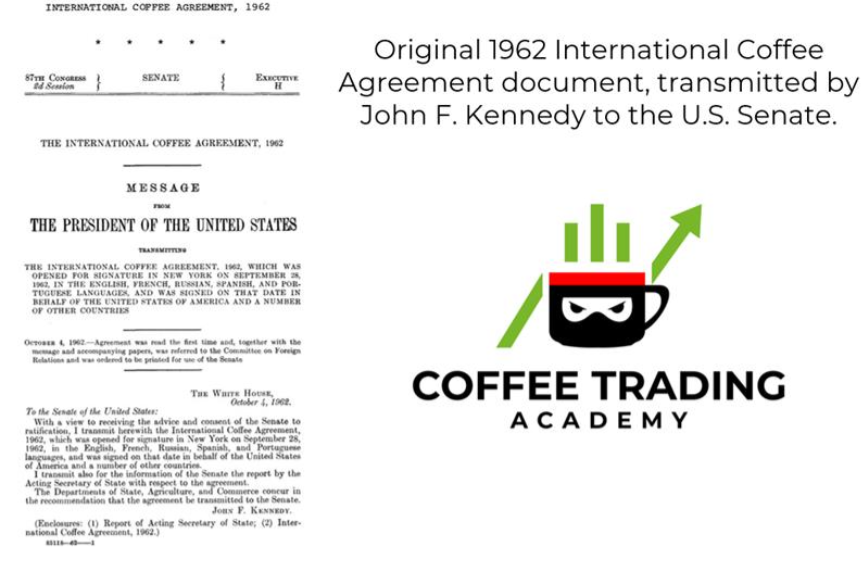
The quota system established under the International Coffee Agreement (ICA) collapsed not because it didn’t work, but because Brazil was sacrificing too much market share to sustain it, while facing major export limitations. It got to a point where the economic incentives became so misaligned for Brazil (and numerous other countries) that there was not enough common ground to sustain the system.
When quotas ended, there was no longer a mechanism to limit exports from origin, and so supply that was stockpiled in origin rapidly flooded the market, leading to the infamous 1989 coffee price crash.
This 1989 crash had two primary effects still felt today. First, it increased the importance of futures prices and ICE certified stocks as elements of price discovery. Second, it drove a huge effort to enhance the value of coffee so that higher prices could be captured, paving the way for larger segmentation, with the emergence of specialty and premium beans.
[Need reliable coffee market analysis? Explore our Coffee Research plans with a FREE TRIAL and stay informed.]
Ultimately, Brazil was the force that led some of the main episodes that were paramount to shaping the coffee market as we know today: from how we think to how we trade coffee.
The Problem with Quotas
The problem with the quota system was that incentives were misaligned. While the system was designed to mitigate Brazil’s massive bearish influence on prices, Brazil was also the most adversely affected, since it was bearing the burden of holding back supply while losing market share.
In a way, Brazil was acting as a kind of “central bank for coffee”: when there’s large global supply, Brazil restricts supply, and when supply tightness, it releases more coffee. However, it was disproportionately Brazil that was carrying this cost.
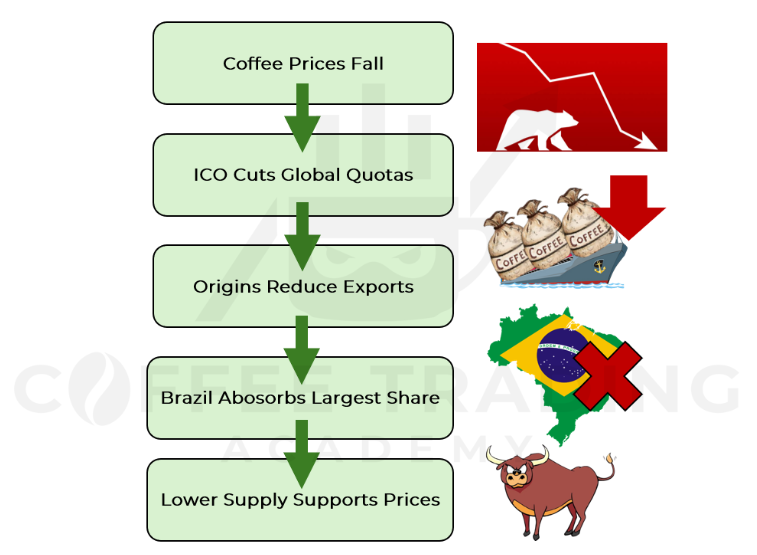
So, frustration grew as Brazil gradually lost market share while it had to sit back and see production expand elsewhere. The price stability sponsored by the quotas made coffee an attractive crop, and this contributed to production increasing in other countries like Colombia, Central America, and parts of Africa.
But that was not the only problem. Importing countries were dissatisfied by the fact that they couldn’t capitalize on lower prices when there were global surpluses, since Brazil and other origins were forced to hold back supply. The system was also rigid in a way that in some cases, importers couldn’t contract the type of coffee that they wanted, even if available in origin.
Meanwhile, producers wanted to maximize profits by boosting exports, so not only Brazil, but other origins also wanted larger quotas, and that was simply not possible to allow, with global production rising.
[Follow the coffee market with confidence. Try our Coffee Research and get clear, consistent market updates and analysis.]
So, while the quota system did provide relatively stable price and supply, it was doing so at great cost. On the one hand, Brazil and multiple origins wanted larger exporting quotas. On the other hand, buyers wanted lower prices and more flexibility for sourcing. These contradictory goals brought the system to a breaking point.
The 1989 Collapse
In July 1989, negotiations to renew quotas failed due to a breakdown in cooperation, and the system effectively ended, in part because Brazil could no longer justify the costs of holding the system together.
The sudden suspension of quotas led to an immediate crash in coffee prices, since the “hidden” supply from Brazil and other smaller origins started flooding the market in the following years, as exports were no longer restricted.

For producers and sellers in general, this was brutal. Revenues collapsed, margins were squeezed, and many origins faced economic stress. The old system didn’t transition smoothly, instead it collapsed into disorder and in 3 years, prices were a third of what they were prior to the quota end.
The surprising move that followed is that, instead of going back to the old ways of restricting supply to control prices, the industry started asking “how can we charge consumers higher prices for coffee?”. This focus forced leading global companies to “reinvent” demand by framing coffee not as a mere commodity, but as a product with tiers and segments.
[Get the coffee market insights professionals rely on. Learn more about our Coffee Research plans.]
The Rise of Differentiation
The 1989 collapse didn’t just crash prices but also forced the coffee industry to create demand-value via increased differentiation of beans. The crisis was therefore a catalyst for the industry to boost the many coffee segments that are popular in today’s market, such as:
Specialty coffees
Premium coffees
Certifications (Fair Trade, Organic, etc)
Direct Trade
Single-Origin (e.g., "Colombian Coffee," "Ethiopian Yirgacheffe")
Micro-lots
This helped roasters and producers protect margins while justifying higher prices through quality, story, and experience. Notably, while those higher-tier coffee industries existed prior to the crash (e.g.: the Specialty Coffee Association of America, SCAA, is from 1982), it was after the 1989 crisis that they exploded.
While this was happening, the futures market was gaining increased prominence in the post-quota world.
Futures and Cert Stocks Gain Importance
The quota system (ICA) collapse had a second-order effect of increasing the importance of the ICE coffee futures markets and the certified stocks.
Before, export quotas guaranteed some level of price stability, which reduced the need for hedging and the risk management tools that futures markets provide. But after Jul 1989, the increased price volatility started to push the need for more hedging and risk-management.
In fact, the futures markets for commodities like coffee were largely unregulated back then. The Commodity Futures Trading Commission (CFTC) was only created in 1974, a late creation that highlights their secondary status on the broader system.
Hence, the financialization, meaning the influx of institutional investors, hedge funds, and speculative capital that we have in coffee today was largely a post-1989 phenomenon.

The rise in futures markets came along with a greater focus on certified stocks, which is the deliverable inventory for the futures market. Certs already existed prior to 1989, but post-1989, they suddenly mattered in ways they hadn't before.
While serving as the physical backing for coffee futures, certs became a visible indicator of how much coffee is available for immediate delivery, and a proxy for supply availability. Market participants started to pay more and more attention to certs as key elements for price discovery.
Almost 40 years later, this is still common practice. In fact, as fundamental analysts at Coffee Trading Academy, we pay special attention to certs.
Conclusions
Ultimately, Brazil was the reason that quotas were established, and it was amongst the main reasons that it ended. The quota end was then a key to shaping the industry into the more sophisticated way that we know today.
History shows that Brazil’s influence on the coffee market goes far beyond sheer volume. While being the largest producer, we tend to think of it as merely the difference between surpluses and deficits, but there’s much more to it.
A great deal of how we think of coffee price discovery and consumption nowadays are second-order effects from a 1989 shock led by Brazil.
That said, while all the “quota drama” was happening, Brazil faced its own problems: soils were becoming less fertile while logistics lost efficiency. This led to a large reallocation of producing regions, and the rise of Minas Gerais as the world’s largest and most famous coffee-producing region.
In the third and last part of this blog series, we will analyze Brazil’s main producing regions, how they weight on Brazil’s total production, and how knowledge on these regions has been helping us forecast Brazil’s production here at CTA.
[Understand what’s driving coffee prices. Access our Coffee Market Research for detailed analysis and forecasts. Get your free trial here!]


Comments