Introduction to Hedging for Coffee Roasters and Traders

One of the biggest challenges that coffee roasters face is the volatility in price of their chief supply component: coffee beans. Over the past 5 years, coffee beans have fluctuated in price from 130 to 430c, and at times intraday swings have been as high as 40c. This means that you could face up to a 10% increase in price, simply depending on when you bought your coffee beans in the morning or in the afternoon!
This exposure to market price fluctuations is known as price risk, and fortunately, you have tools at your disposal to manage this major hurdle in our beloved little coffee market. One of the most useful tools in this regard is hedging.
In this article, we will introduce the concept of hedging and how to use it in your business.
Here’s the plan: first we will provide you with a working definition of hedging, then we will discuss the two key concepts essential for understanding hedging (positions and price risk), and finally, we will conclude with an explanation of position management: the art of managing price risk through purchases, sales and hedging.

What is hedging?
Hedging is the solution to a particular problem: price risk.
The actual mechanics of hedging involve a technique of removing price risk without removing a position. We will go into the exact mechanics of how that works, but first a little background.
To understand hedging, you need to understand two related concepts: “positions” and “price risk”.
[Understand what’s driving coffee prices. Access our Coffee Market Research for detailed analysis and forecasts.]
A position is the total amount of your exposure to an asset. This means how much of an asset you own minus how much you owe. If you own a stock, real estate, or a commodity, your net worth will go up or down based on the value of that asset. This is your exposure.
For coffee roasters, your position is a “natural short” (meaning normal operations put you at a deficit in physical coffee). For example, a roaster may have 100 bags of coffee in their warehouse now, but since they roast coffee continuously (at say 100 bags per month), over a 3 month period they would be “short”. In this case they would need to roast 300 bags of coffee, but only have 100 on hand, so they would still need to buy 200 bags (100 - 300) just to finish the quarter.

Price risk is your exposure to the fluctuations in a market. So, if you are a roaster who needs to buy coffee every month for your business, and every month the price of coffee changes, that is price risk. One month, your coffee might cost you $3.00 per lb, one month it might cost $4.20 per pound, another month it might cost $2.50. This volatility in the price of coffee is your price risk.
In our price examples above, if a roaster must buy 200 bags of coffee and the market is at $2.50, they will pay $66,138.
One bag is 60 kg (about 132.277 lbs),
• 132.277 lbs × $2.50 = $330.69 per bag
For 200 bags:
• 200 × $330.69 = $66,138
[Want to learn how the coffee market really works? Join our Coffee Trader’s Course and build practical market knowledge.]
However, depending on where the market is before they buy, their cost will change:
• At $3.00/lb → 132.277 × 3.00 = $396.83 per bag → 200 bags = $79,366
• At $4.20/lb → 132.277 × 4.20 = $555.56 per bag → 200 bags = $111,112
• At $2.10/lb → 132.277 × 2.10 = $277.78 per bag → 200 bags = $55,556
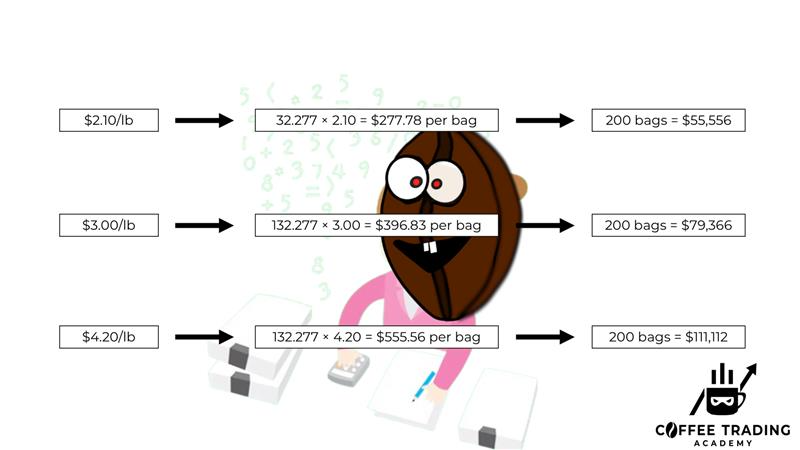
These vast differences in total costs for the roaster (from $55k to $111k for the same 200 bags) illustrate the roaster’s exposure to price risk.
Their business must buy the coffee every quarter, but the cost is uncertain until the moment they purchase it. As you can imagine, this can make budgetary planning very difficult and can have a major impact on whether a business is profitable (i.e. sustainable) or not.
Given this risk to the viability of a business, it is no wonder that roasters and others in the coffee supply chain look for solutions to mitigate that risk. Hedging is one of the most popular solutions to do so.
Mechanics of Hedging
It is a common misconception to think of hedging as simply removing price risk. Hedging does remove price risk, but that is not the whole story. There are multiple ways to reduce price risk: you could also decrease your volumes or cover open positions to reduce your price risk. What hedging really does is provide flexibility on when and how to take on or take off price risk.
Hedging operates on a very simple principle: the only way to offset price risk is with equal and opposite price risk.

For any security, be it a house, equity, bond, commodity or currency, if my position is long (i.e. I “own” it) I have price risk. If the market for that security goes up, I make money. If the market goes down, I lose money.
The easiest way to remove this price risk is to liquidate this asset (convert the asset to cash). If I own a house, I’m exposed to the fluctuations of the housing market, but if I sell the house, then I am no longer exposed to the fluctuations of the housing market.
Derivatives
However, there is also another way to remove this price risk, and that is with derivatives. Derivatives are special financial instruments whose price is “derived” from another asset.
[Stay on top of the coffee market. Sign up for our Coffee Market Research and get timely insights delivered to your inbox.]
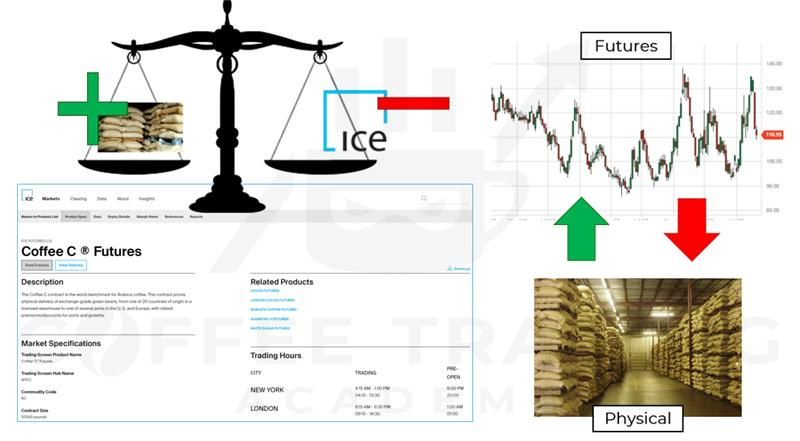
In commodity markets like coffee, corn, gold and energy, we use futures as our derivatives. Each future has a price that exactly corresponds to the price of the physical asset. So instead of liquidating the asset itself (sell longs or buy back shorts), you could trade an equivalent number of futures contracts.
Hedging Examples
Hedging (offsetting an asset with an opposite but equivalent number of derivatives) offers several unique advantages. First, the speed and liquidity of the derivatives markets (futures in the case of coffee) allows Roasters, Producers and Traders the ability to rapidly take advantage of beneficial prices when they appear. Second, the unitary nature of derivatives (i.e. they are made up of small, identical units) means that they are very easy to incrementally take advantage of prices.
For example, let’s say you are an exporter in Uganda. You have purchased 100 MT of physical robusta coffee at an avg price of $3000/MT. You can typically sell to importers in Europe about 10 MT per week. However, now the price has risen to $4000/MT, and you think this is a good price.
From here, you would have a few choices. You could try to sell all of your Robusta right now to importers, but if this is more volume than your clients need at present, you may have to dramatically lower your prices to sell it all. Moreover, this might be logistically difficult or impossible to arrange for the rapid export of all your inventory.
[Get the coffee market insights professionals rely on. Learn more about our Coffee Research plans.]
Alternatively, you could use the futures market to hedge your inventory. Let’s look at three different choices for hedging. 1) simply sell 100MT worth of futures against your 100 MT of physicals. 2) hedge some of your inventory now and wait to hedge the rest later, 3) hedge your inventory on a partial basis over a period of weeks to obtain a market average.
Option 1, hedging all your inventory at once would happen instantaneously at the moment that you like the price. Now you would be free to sell your physical inventory 10MT at a time with no hurry to chase price. As the physical sales are booked, you would simply lift the hedges.
Option 2 choice would be to hedge some of your inventory now and hedge the rest later. If the exporter thought $4000/MT was a good price, but that prices may continue to rise, you could simply sell 50 MT of futures vs your 100MT of inventory, then if prices rise another $200 or so, then you might sell the rest at the higher price of $4200. If prices fall by $200 then you could continue to wait (having already sold half at $4000) or if you are now bearish on prices, then you could sell the remaining 50MT at current market levels.
Option 3 is taking an average price over time. This might be if the exporter was unsure about prices and simply wanted to reduce the volatility of the market and the stress of choosing tops or bottoms in the market. The exporter might simply sell 10 MT of futures every week, regardless of the price and this would guarantee them an average price of the market over a period of say 5 weeks.
These are only a few of the choices available to a hedger. The hedger is only limited by their imagination. However, in order to hedge, the coffee professional must understand position management.
Position Management
Position management is the skill of being able to organize what assets they are long or short over time. The position is made up of two broad categories of exposure: physical and market exposure.
The physical position is made up of 3 components: Inventory, Open Purchases and Open Sales. When summed together, this gives the basis position, or the total physical coffee.

A trader or roaster should be able to manage their position on paper, if need be
The market exposure is your total physical position plus any offsetting hedges. This would include futures, options and any price-to-be-fixed (On-Call) contracts.

For a roaster, your position would look a little different in that you wouldn’t necessarily have open sales, and you would have a roasting schedule that consumes your supply of green coffee.
Properly organizing your exposure in a table like this is essential for hedging because you need to be precise in your calculation of what your exposure is in order to properly reduce that exposure.
[Build real coffee market expertise. Enroll in the Coffee Traders' Course and learn from industry professionals.]
Let’s look at an example.
If you are a roaster with 40 MT of inventory and 50 MT of open purchases (not yet delivered) and you plan on roasting 200 MT of coffee this quarter, then you would be 110 MT short in your physical book. In other words, you still need to buy 110 MT worth of coffee in order to meet your roasting schedule.

If you have no hedges, then you would also have -110 MT of market exposure. This means that if the market rallies you would lose money and if it falls you would make money. So, if the market falls by $10, then you could buy your 110 MT $10 cheaper. If it rallies by $30 then it would cost you $30 more to buy your coffee.
In order to hedge this exposure, you would need to trade futures or similar derivatives. Since the roaster is short physical coffee, you would need to buy hedges. To be perfectly flat, they would need to buy 110MT worth of futures.
Conclusion
Hedging is a key tool for reducing price risk. It is not about eliminating price risk per se, but rather about being mindful in how you are reducing it.
One of the benefits of hedging is providing stability to your business. We often talk about the concept of sustainability in the coffee market, meaning that we want coffee production to be environmentally friendly and allow for a living wage for the coffee producer. However, it is also important that our roasters make their businesses sustainable too. This includes aspects of corporate social responsibility, but also preparing your business for the possibilities of price shocks too.
Understanding hedging, and preparing your business to use hedging tools is an essential step in ensuring that your coffee business will survive through a variety of different price environments.
For more in depth training on hedging and understanding the coffee market, check out our upcoming Coffee Trader’s Courses, and prepare your business to prosper over the long-term.
[Take your coffee market knowledge further. Learn the fundamentals and market mechanics in the Coffee Trader’s Course.]


Comments