A Hard Look at Uganda's 20M Bag Coffee Goal

In the 24/25 season, Uganda has emerged as one of the strongest coffee export stories in the global market. Export volumes surged to record levels in 2024/25 and have remained strong in the current season.
And this is no coincidence: Uganda’s export strength reflects a deliberate push in its coffee sector. Supported by Uganda’s replanting programs, expanding acreage, and favorable weather, the country is steadily boosting production, as implied by the sustained high exports.
In this article, we look at the Uganda’s export surge and ask the big questions: what has drove Uganda’s coffee boom? Is Uganda on track to hit its ambitious target of doubling production by 2030? If so, what could that mean for global coffee supply and demand?
We start by reviewing where the Ugandan coffee sector comes from and where it stands today, then explore the potential path ahead for its coffee expansion.

Context
Uganda has set a bold target of raising coffee production to 20m bags by 2030, and recent export figures suggest the country is already making significant progress toward the target. In the 2024/25 season, Uganda exported a record 8.2m bags, cementing its position as one of the world’s leading coffee exporters, behind only Brazil, Vietnam, and Colombia.
[Stay on top of the coffee market. Sign up for our Coffee Market Research and get timely insights delivered to your inbox.]
This export surge follows the 2017 launch of Uganda’s “Coffee Roadmap” - a strategic plan by the UCDA (Ugandan Coffee Development Authority) and the MAAIF (Ministry of Agriculture, Animal Industry and Fisheries) - backed by government incentives to raise coffee production and expand acreage.
The plan was enacted because coffee - and its export revenue — is seen as a key driver of Uganda’s economic growth.

Since the plan was set, Uganda has made remarkable progress, rising from the 7th to the 3rd largest global coffee exporter in just a decade, and almost doubling annual production from ~4m to ~8m bags a year. The important point is this: if Uganda achieves its bold 20 million‑bag target by 2030, it would add around 10-12m extra bags a year to the global market — mostly robusta — and enough to shake up supply and demand.
So, the questions are: can they actually pull this off by 2030? How close are they to getting there? Well... we’ll tackle that shortly, but first, we need to understand the factors that determine how achievable this goal truly is.
Farmers Can’t do it Alone
Doubling production in such a short time is an ambitious goal that requires strong support. Ugandan farmers wouldn’t be able to achieve this on their own without government incentives, even with strong backing from favorable weather. Notably, not only does Uganda aim to ramp up production—it also wants to promote its coffee as high-quality and shake off its reputation as a “low-grade” supplier.
[Need reliable coffee market analysis? Explore our Coffee Market Research plans and stay informed.]
On their own, farmers would face challenges that make reaching 20m bag production a nearly impossible task: aging crops (some sources estimate an average tree age of a few decades), a cultural mindset that treats coffee merely as a cash crop, with little emphasis on quality, lack of sophistication and a urban migration that’s leaving coffee farms short on labor.
The Ugandan authorities saw through the issue and implemented incentives that have become essential for achieving its ambitious goal.

The main initiatives are:
Large-scale seedling distribution in the scale of hundreds of millions per year
Quality and sustainability training for farmers
Incentives and financial backing for both smallholders and private companies
Including distribution of free or subsidized fertilizer
With easier and more affordable access to fertilizer, plus the favorable weather from the past few years, Ugandan farmers have been able to take better care of their coffee crops. It seems that in Uganda – much like in Vietnam (another major Robusta-grower) - these improvements in farm management have played a significant role in supporting production growth.

Seedling Distribution
To hit its production target, Uganda needs to tackle two core issues: rejuvenating an aging coffee tree stock—many plots are several decades old, dragging down yields—and expanding planted acreage. One of the main tools to drive both has been large-scale seedling distribution.
Under government-led programs such as the Coffee Roadmap and Operation Wealth Creation, most coffee seedlings are distributed free of charge to farmers. The aim is to encourage replanting and area expansion, given the high cost of seedlings and the scale of renewal required.
[Looking to strengthen your coffee market knowledge? The Coffee Trader’s Course provides practical training and real examples.]
These distributions are typically paired with agronomic support – in some cases, via joint ventures with private companies - including training on planting, pruning, stumping, pest control, and broader farm management practices.
Analyzing historical data, we noted that before the Roadmap (pre‑2016), seedling distribution was comparatively low and irregular (mostly tens of millions a year), whereas since the Roadmap push, seedling distribution scaled up to the hundreds of millions annually, contributing to a cumulative >1 billion seedlings distributed since.

Based on seedling distribution and standard planting densities, Uganda’s coffee roadmap implies a gross planting capacity of ~1.15 million hectares since 2016. Assuming that 30–40% of seedlings went toward net expansion rather than replanting, this translates into about 350–450k hectares of new area. That’s broadly consistent with the near-doubling of production since 2018.
Note that we’re assuming only 30–40% of seedling went to area expansion, since UCDA reports show that a large portion of seedlings was used to replant existing old trees. If all seedlings had gone to new acreage, production growth would have been much higher.

Impact on Production
While Uganda’s coffee push is clearly delivering results, reaching 20m bags of production by 2030 looks unlikely under current trends. Based on back-of-the-envelope estimates, doing so would require distributing an average of almost half a billion seedlings per year between 2026 and 2030 — well above even the peak years of the 2016–2019 expansion phase.
[Join our Coffee Trader’s Course and build practical market knowledge.]
Note that seedling distribution is a first-order proxy for what is realistically achievable (as seen in the 2018-2025 data), so it’s effective at ruling out implausible outcomes, which is exactly what we’re aiming to do here: if the math says half a billion seedlings per year are needed and historical distribution is far below that, the target is simply not feasible.
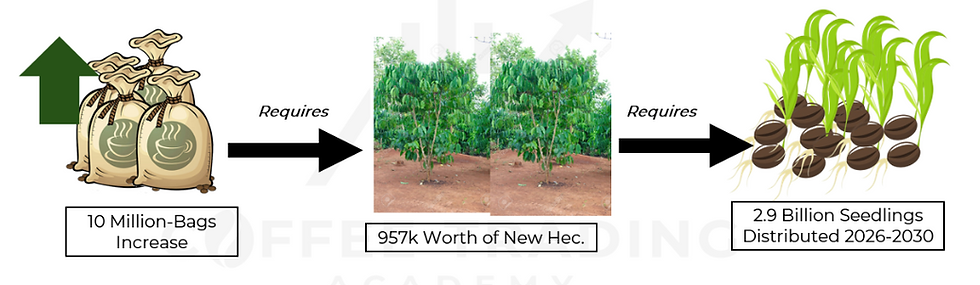
That is, unless planting accelerates materially and is sustained without interruption, but that’s a big “IF” and we don’t have enough evidence (such as a UCDA seedling distribution commitment) to back up such outcomes.
Even if Uganda’s coffee roadmap now shifts more toward net acreage expansion rather than replanting with the seedlings they distribute, achieving the scale required to reach 20m bags per year in just a few years remains low probability.
Beyond policy execution, there is also a variable the government cannot control: weather. Recent production volatility in countries like Brazil — where frost and drought that have affected production — has shown how climate shocks can significantly disrupt output, and Uganda is not immune to such risks.
[Understand what’s driving coffee prices. Access our Coffee Market Research for detailed analysis and forecasts.]
Taken together, this doesn’t mean production cannot keep rising — only that the scale of growth is likely to fall short of the 20-million 2030 target. Ultimately, Uganda’s steady production gains suggest momentum is real.
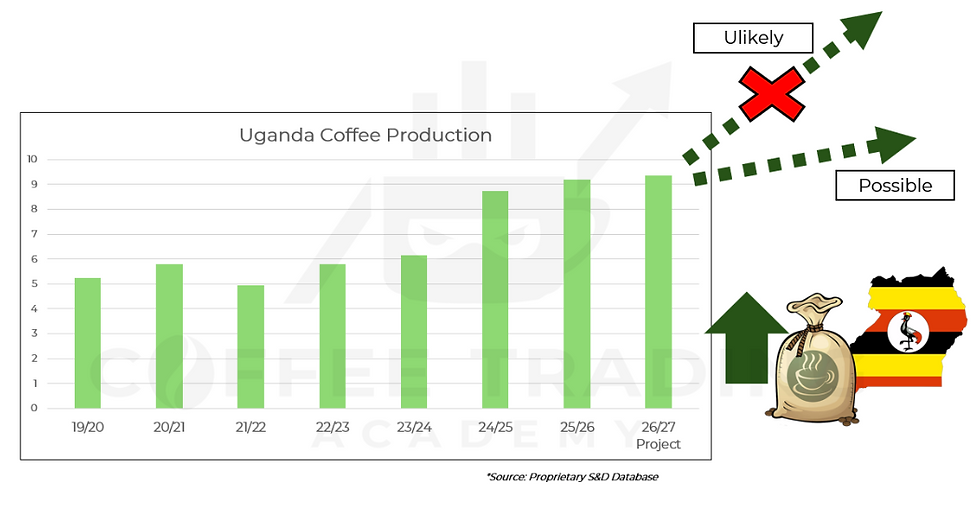
Realistically, Uganda can likely sustain production in the 9–10m bag range over the next few years, or in a favorable scenario — with improved planting intensity, supportive weather, and strong execution — approach 15m bags. Reaching 20m bags by 2030, however, would require a scale and consistency of planting, yields, and execution that has not yet been demonstrated.
Conclusion
While Uganda is making real progress and production momentum is evident, the 20-million-bag target for 2030 appears out of reach under current conditions.
This becomes clear not only from the need for unprecedented levels of seedling distribution, continuous replanting, and near-perfect execution, but also because even flawless implementation would still depend on weather, which is an unpredictable factor.
However, this doesn’t mean Uganda can’t eventually achieve its goal; it’s just that it will likely take more time than originally planned. Based on how things are progressing, it’s possible that Uganda’s production continues to gradually rise, even if at a relatively slow rate.


Comments