Anatomy of a Coffee Market Sell-Off (Jan – Feb 2026)

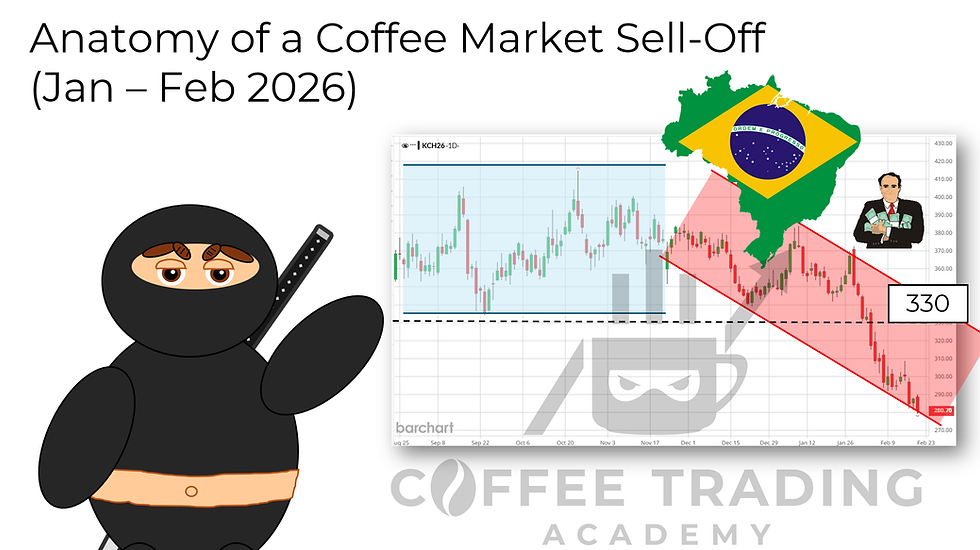
Coffee prices fell 70c, or roughly 20%, in just three weeks, and when coffee markets move this sharply, questions naturally arise: what sparked the selloff, why did prices fall so abruptly, and why did this only happen when prices broke a certain threshold?
In this blog, we break down the factors behind the coffee market’s fall and analyze how they combined to culminate in such a rapid selloff.
What Caused the Selloff
In short, the selloff was driven by a mix of Supply and Demand fundamentals and market positioning.
The widely anticipated record Brazil crop — to be harvested in May — acted as the catalyst for prices to breach below a key threshold (330c). Once that level was broken, it triggered a “snowball effect” of speculative selling, fueled mostly by liquidation of the long positions built in August.
Put simply, two factors drove the selloff: the catalyst (Brazil) and the vehicle (speculative selling). In the following sections, we will examine each in detail.
[Start a free trial of our Coffee Research and see what you’re missing.]

The Catalyst: Brazil
Prospects of a record Brazil crop can be interpreted as the trigger for the selloff. Brazil’s 26/27 crop is widely expected to set new records—both in total production and in Arabica and Robusta output — and this outlook has largely eased the supply concerns that had been dominating coffee.
To put it in perspective, the previous Brazil record crop was somewhere close to 70m bags, while consensus for the upcoming crop (i.e.: the average of public estimates) is even higher, surpassing 73m bags.
However, a large Brazil crop had been expected for months, yet it only turned market-moving in late January, which raises the question: why the selloff now, and not earlier?
Our view is that in late January—unlike earlier in the cycle—the market reached critical mass in terms of certainty vs uncertainty of the coming Brazilian coffee crop. The accumulated and forecast off-season rains now confirm minimal downside risk to the coming crop potential.

The off-season rains were “highly favorable” (quoting a farmer) to crop growth, and this reinforced confidence in a large crop: what had previously been weather-dependent had, by late January, been validated to a large extent by realized rains and the forecast weather for the remainder of the crop does not show any large risks.

[Want better context around coffee price moves? Explore our Coffee Research with a free trial.]
We have made the case that Supply and Demand fundamentals (dominated by Brazil crop certainty) was the main driver of the price decline, and we have shown that this solidified in late Jan. But that alone doesn’t explain why the selloff was so rapid—or why it only accelerated once prices broke the 330c threshold (why not 345c or 320c?).
The answer to this question lies in our next topic: spec positioning.

Positioning: The Selloff’s Engine
The selloff really accelerated once prices broke decisively below 330c, because that level triggered heavy selling from speculators. Long positions that had powered the Aug–Sep 2025 rally were placed just below 330c, so when prices slipped past it, those positions that were once quite profitable, were now losing money.
The CFTC COT reports confirm this, by revealing that since prices broke 330c, specs sold a hefty 18.3k lots—11.2k from long liquidation and 7k from new shorts jumping on the bearish trend.

What made the selloff so fast was the way spec long liquidation feeds on itself. Once one long liquidates at a P&L loss (or on the verge of it), that selling pushes prices down further, which makes more longs into P&L losses who in turn sell their positions, and the cycle repeats. Sometimes (but not always), this creates a “snowball” effect, and that’s exactly what we saw in coffee.
But this was not a major surprise for those familiar with how positioning works... Ahead of the selloff, we had identified 330c as a key selling level for our premium-report clients. Not because we can see the future, but because positioning made the risk level clear.
Given the size of embedded long positions all the way down to 270c, and mostly below 330c, it was reasonable to infer that a breach of 330c had the potential to push prices quickly toward the 270–280c range in the more aggressive scenario, since this is where longs began adding back in Aug-2025.
The selling was further reinforced by the bearish 20-day/200-day moving average cross on Feb 3rd, which acted as a bearish signal for specs, likely giving them extra confidence to sell.
[Stay informed as the coffee market evolves. Sign up for a free trial of our Premium Coffee Research today.]

It was also amplified because long hedgers (roasters buying futures) held back as prices fell, allowing spec selling to cascade more quickly. Had long commercials hedged more aggressively once prices fell; their buying would have acted as a brake to the selloff.
Although long hedgers did step in, their buying amounted to less than half of the spec selling, leaving an imbalance that allowed the selloff to snowball.

Conclusions
Ultimately, the sequence of events is clear: expectations of a large Brazil crop acted as the initial catalyst, and once prices broke decisively below 330c, long positions were liquidated while short speculators joined the trend. This created a snowball effect, and with few long hedgers stepping in to provide committed buying, the selloff was able to unfold rapidly and with significant intensity.
This episode shows why staying ahead of the market and taking a holistic approach is crucial. The selloff caught many off guard, but those attentive to fundamentals and positioning had a clearer sense of what was coming.
This is exactly what we offer in our premium reports: early warnings and insights based on thorough analysis, helping our clients anticipate coffee market moves. If you’d like to test it for yourself, we invite you to start a free trial of our Premium Coffee Research.
[Enjoyed this blog? Sign up for a free trial of our Premium Research and get access to exclusive blogs and research!]


Comments