Cocoa Grinding Differences Across Regions – Part 1

Introduction
The grinding figures were one of the main points of cocoa markets in 2025. Over the last year, we saw grinds collapsing in all the main regions, leading the accumulated NCA, ECA and CAA numbers to fall 6.7%.
Beyond just the downtrend, though, 2025 grindings told a story that was more than “high prices hurt demand.” The same global bean shock hit every region, but the way it impacted each one could not be more different. While Europe saw a consistent decline, Asia had both the heaviest fall and the swiftest recovery, and North America surprised the markets with its resilience.
In part 1 of this 2-part blog series, we will look into the impacts of the surging cocoa prices on the cocoa demand of these three global cocoa and chocolate giants.
[Want better cocoa market insight? Start a free trial of our Cocoa Research and get access to expert analysis and key market data.]
Price overview
To understand grinding dynamics, a useful starting point is the price path through 2025. Besides the obvious notion that higher prices reduce grinding, by looking at the details, we can see how the rally actually interacted with each region’s processing structures.
Following the extreme highs of late 2024, cocoa prices corrected sharply through 2025, falling from over $11,000 to just $6,000. Even after that correction, though, cocoa was still expensive relative to the pre-2023 regime, meaning manufacturers were not “saved” by the decline; they were simply moving from an emergency pricing environment into a still-elevated cost base.
This fact, along with the way companies deal with prices and their variation, is an essential context to have before exploring the grinding changes in the four quarters of 2025.

Europe
The Giant’s Fall
Starting with the biggest chocolate consumer on the planet, Europe’s grinding decline was steady and broad-based, gaining strength over time and remaining more consistent than the other regions. In Q1 2025, European grindings fell by 3.7% YoY, a very similar number to what was seen in North America and Asia. In Q2, though, was when the divergence happened; while North America gave early signs of recovery and Asia plummeted, Europe was in the middle ground between the two extremes, increasing its Q2 drop to 7.2%. This was then reduced to 4.8% in Q3 but rose to its highest level of 8.3% by Q4.
[Curious what’s driving cocoa prices? Try our Cocoa Research free and stay informed on supply, demand, and market trends.]
Of course, “more consistent” does not mean that the impact was smooth, only that different quarters showed a more similar reduction YoY.

European Industry
To understand Europe’s grinding movements, we must first know its role in global processing, and here, “connection” is a key clue about the Old Continent’s market mechanics. Beyond being just a consumer, Europe is the world’s largest cocoa processing hub and an export-oriented one, with a highly developed industrial chain that supplies both domestic consumption and global confectionery and manufacturing demand.
Such a structure would typically provide scale advantages, but in 2025 it meant Europe was exposed on multiple fronts at once: not only did European households face higher chocolate prices, but processors were also serving international customers that were in different situations from their own internal markets. Considering North America and Asia were at extreme opposites, Europe became the average of the two, especially in the earlier quarters.
[Looking for reliable cocoa market research? Sign up for a free trial and see what our Cocoa Reports include.]
At the same time, the developed and highly concentrated level of the European processing market also contributed to delaying the impacts of the cocoa rally. European companies, especially the large industrial players that are mostly concentrated on the continent, tend to use hedging to increase predictability and reduce risks. It is estimated that around 50% of the processed cocoa had its prices locked in for around six months beforehand.

Impact
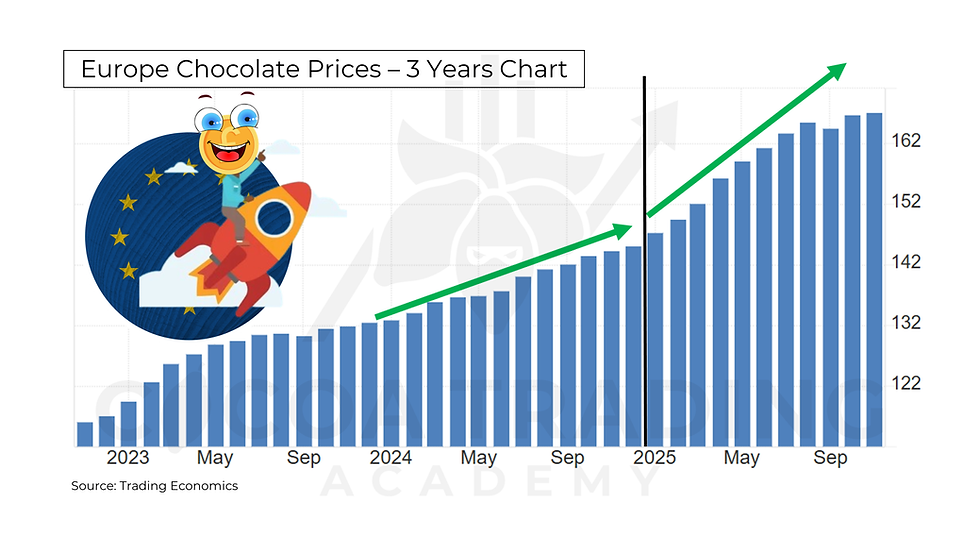
By looking at the inflation indexes, we can see how this protection played an important role in reducing the impact of the high prices on cocoa demand. Although most of the rally happened in 2024, when prices rose from $4,000/MT to above $10,000/MT, chocolate prices only increased by 9.8%. On the other hand, during 2025, chocolate inflation was 15.2%, despite cocoa prices having finished the year at $6,000/MT.
This divergence happened because, for most of 2024, cocoa prices were still locked at lower levels, whereas in 2025, companies instead hedged their beans at a far higher price, fearing cocoa could reach even higher prices. As a result, these factors slowly accumulated, leading to the worst outcome in Q4 2025, when European processing reached its lowest level in 21 years.
For Europe, demand weakness was not a one-off reaction to sticker shock; it became a gradual, compounding adjustment as consumers stopped buying, hedging lost its effectiveness, and manufacturers leaned harder into “hidden” price actions like shrinkflation and recipe optimization rather than maintaining volume.
Asia
The Rookie
While Europe showed a gradual but consistent reduction in grinding figures, Asia was the region where the adjustment was by far the most abrupt, adding to the rapidly growing list of things the cocoa markets had never seen before. To understand such intense variations within the span of a single year, we must investigate the particular nature of Asian processing hubs.
Unlike Europe and North America, cocoa and chocolate have never been at the heart of the Eastern continent. Instead, processing started to pick up in the 1990s, when Malaysia became a major grinder due to tax incentives and proximity to Indonesian beans. Indonesia itself followed in the early 2000s, attempting to capture more value from its own production. The trend intensified even more in the 2010s, as these countries increased their processing and were followed by others, such as Singapore.
[Follow cocoa markets with more confidence. Start a free trial of our Cocoa Research and get timely market insights.]
Combined, these efforts led Asia to become the second biggest cocoa grinding region in the world. By its history, though, we can see that, even if consolidated, the Asian processing industry is still very young and immature in many aspects.
One of the best ways we can notice it is by looking at the use of hedging by companies. While European grinders tend to lock around 50% of their cocoa prices in advance, or even more in some cases, the Asian ones hedge approximately 30% of their beans, a far smaller rate. When talking about North America, as we will do in the future, the difference is even larger.

The Roller-Coaster
The lack of hedging led the 2023/24 rally and the subsequent price drop in 2025 to impact the Asian industry at a far faster pace than what we saw in the other regions. Combined with other aspects, such as bean differentials, credit conditions, and inventory financing, it made the high prices and volatility of cocoa much more costly for companies, leading them to reduce throughput, sometimes even before end consumers reacted to the higher costs.
But Asian consumers do react, which leads us to the last reason for the grinding numbers we saw last year. Even if chocolate consumption has grown fast over the past decade, it continues to be more discretionary, gift-oriented and premium-positioned relative to other consumables. While European countries consume between 6kg and 10kg of chocolate a year per capita, and US figures come slightly below at 4.5kg, Asian consumers present far lower numbers, with most countries having a chocolate consumption rate below 1kg per capita.
Instead, the cocoa grinding figures are more a result of the large population than of the love for chocolate itself. As a result, if the sweet becomes too expensive, consumers are more likely to just replace it with cheaper snacks, local sweets, or make fewer impulse purchases, making Asian demand far more sensitive to prices than in the other regions.
[Get a clearer view of the cocoa market. Explore our Cocoa Research with a free trial and see the value for yourself.]
Together, these factors led Asian grinding figures in 2025 to become a full roller coaster, capable of making one nauseated just by looking at the graph. From a mild 3.6% drop in Q1, a little worse than North America but better than Europe, cocoa processing plummeted to a 15.5% reduction in Q2, the largest in the historical series. The fall became even steeper in Q3, when the total processed cocoa was 17.1% below 2024 levels.
For Q4, though, we saw a considerable sign of improvement, as the YoY drop was reduced to “only” 8.2%, already better than European figures for the period, even if still terrible. As it happened during the rally, Asia was the first region to react to the subsequent bear market, that became more intense by the end of 2025.

Conclusion
The two biggest cocoa processing regions, Europe and Asia, presented very different conditions. While the former had a stable decline for most of the time, the latter showed an almost instantaneous reaction to everything that happened to international prices, be it the 2024 rally or the 2025 drop.
This contrast is a direct consequence of the nature of each industry and how consumers see chocolate. Only by understanding such aspects were we able to explain why each region reacted the way it did.
In the second part of this blog, we will compare the results of these two regions with North America, the third processing hub of the grinding associations. We will also take a look at other relevant cocoa processors, such as Ivory Coast, as well as what we can expect of the grinding figures moving forward.
[Enjoyed this? Get access to exclusive blogs and premium cocoa market research by signing up for one of our cocoa market plans.]


Comments