Coffee Exports Rising but Destination Stocks Still Low

Global exports have been improving over the last two seasons, yet destination stocks remain low. The obvious conclusion is that consumption is good, with demand rapidly absorbing the incoming supply and keeping inventories under pressure.
In this article, we’ll go deeper into this matter and explore the mechanisms that are keeping stocks low, including not only consumption, but also high carry costs as plausible explanations. We’ll look at the numbers and see what would need to happen for stocks to start building again.

[Want better insight into the coffee market? Start a free trial of our Premium Coffee Market Research and see what you’ve been missing.]
Context
Before getting into the numbers, I think it’s useful to establish a simple timeline to put things into context:

This is the timeline to help situate ourselves:
Brazilian supply was hit by frost and subsequent weather problems between 2021 and 2023
This contributed to global supply deficits, a decline in global exports and spread inversion
The result was a drawdown of stocks in destination markets to multi-year lows since 2021
These series of events explain the current low stocks. We have been in deficits for a few years, and we just got a big Brazil crop that’s not totally available, so it makes sense that stocks haven’t rebuilt.
This leaves the coffee market with a small buffer against supply shocks, and it’s seemingly one of the factors (amongst others) that help explain why coffee prices are high.

The Disconnect: Global Exports vs Stocks
Global exports have increased considerably over the last two seasons, without a corresponding build in stocks. Exports rose from 123m bags in 21/22 to 139m bags in 22/23, 140m bags in 24/25, and seemingly on track to surpass 140m bags again this season.
If global exports have gone from roughly 123m bags to 140m+ bags, that's around 17m additional bags of annual export flow, compared with 21/22.

Since a large share of those exports ultimately goes into major destination markets, we'd intuitively expect at least some of that additional coffee to show up as higher inventories in ECF, JCA and cert stock reports.
Instead, not only did stocks fail to increase, but they actually fell further this season.
[Stay on top of coffee market developments. Try our Premium Coffee Research free and get regular market insights and analysis.]
Why aren't Stocks Rebuilding?
The most reasonable explanation is that holding coffee has become too expensive to justify stockpiling.
A strongly inverted futures curve (a result of the early 2020s deficits) means that a trader who wants to maintain a hedge on physical inventory must pay to roll that hedge forward every 3 months, so in other words, the market is effectively penalizing inventory accumulation.

So, the most economically rational response to a persistent inversion is to reduce inventory rather than carry it. To better understand why, let's look at a theoretical example.
A simple example
Suppose a US importer owns the equivalent of 50 containers of Brazilian Arabica and has a futures hedge against it, so he owns physical coffee and a short futures position.
If the market is inverted by 10c, rolling that short hedge forward will be costly. The importer effectively has to buy the deferred contract and sell the nearby, giving up ~10c.
Roll Cost
The ICE Coffee C contract represents 37,500 lb, and we can assume that 50 containers equal 50 lots (for simplification), so the math in this example would be:
50 contracts × 37,500 lb × $0.10/lb = $187,500
So, the importer would need to pay 187 thousand dollars to carry that position, separate from warehouse, insurance, and financing costs. That's a very meaningful cost simply to carry coffee.

In fact, that cost can be even higher. As I write this article, we're approaching First Notice Day on the Sep (U) contract on a +30c inversion, so rolling the same 50-lot position from our example right now would imply a cost of approximately $562,500.
[Looking for reliable coffee market research? Sign up for a free trial of our Premium Reports today.]

Financing Cost
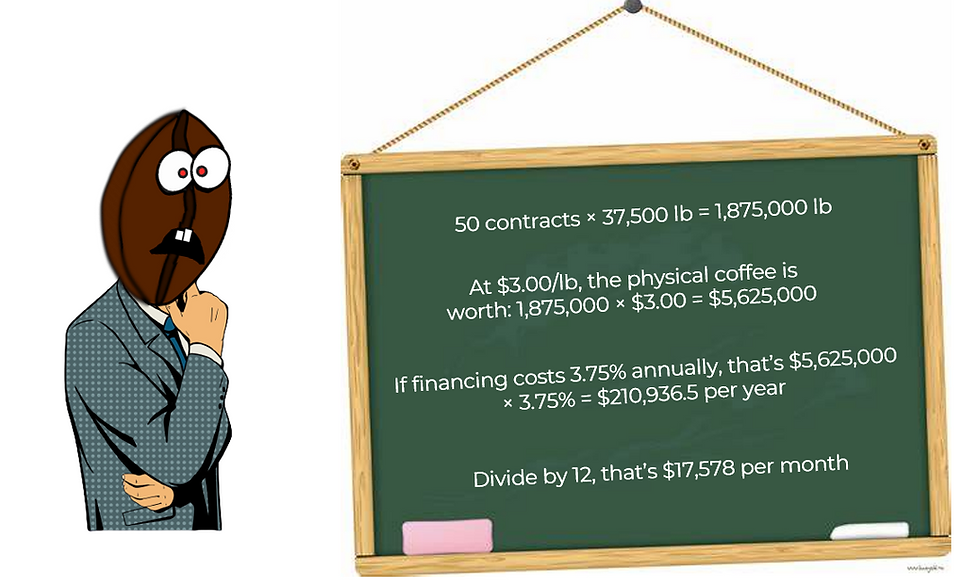
Moreover, the high interest rates make stockpiling even less attractive. The US has had high interest rates since late 2022, now at 3.5-3.75%. This means that on that same example, on top of the roll cost, carrying that coffee would cost $17,500 monthly on financing.

Even if the importer used its own money rather than borrowing, he would still be having this same $17k/month as an opportunity cost of the capital tied up in the physical coffee.
Notably, that's been the case for roughly 4 years, the same 4 years at which destination stocks have been drawing down.
Below is the interest rate math, for reference:
Positioning as Evidence
The COT data seems to provide evidence that commercials may be avoiding carrying hedged coffee. The Commercial short position is well below typical levels (50 thousand lots below the 5-year average), sitting near the lower end of the multi-decade range.
This suggests that traders are holding less short exposure than usual, likely unwilling to carry hedged coffee inventory.

Evidence of Good Consumption
If more coffee is being exported but not stockpiled due to the high costs of carrying, the obvious conclusion is that consumption is solid.
Coffee is more likely being sold, roasted and consumed in a “hand-to-mouth” approach where commercials buy and consume coffee as needed instead of stockpiling and carrying.
[Try our Premium Coffee Market Research free and get detailed analysis of the market.]
I believe we can also add that, after four years in this environment, traders may have adjusted their inventory management. They now have a better idea of the timing and volume of coffee they need to fulfill their obligations.
When you're used to stockpiling, operating this way can be difficult at first, but after four years, you probably have a much better idea of what you actually need and when you need it.

There are other alternatives too, but they have their own drawbacks. Traders can remove the hedge and keep the physical coffee, but that leaves them exposed to outright price risk. They can also move coffee to cheaper or private warehouses, which reduces physical carrying costs but doesn’t solve the high roll costs. Neither of these come across an optimal solution.
Conclusions
For stocks to really start rebuilding, the inversion needs to break and carry needs to be restored, so that holding physical coffee becomes attractive. Historically, carry markets have gone hand in hand with high certified stocks (see the chart below), which in turn requires washed differentials to fall below tenderable parity levels to make certification economically attractive.
There is, therefore, a “chicken-and-egg problem”: stocks need the inversion to break, but breaking the inversion may first require certified stocks to increase. Until that feedback loop is broken, there might be little incentive to build stocks.
[Stay ahead of changing coffee market conditions. Start a free trial of our Premium Coffee Reports today]


Comments